5 Hidden Costs of Manual Water Tank Management
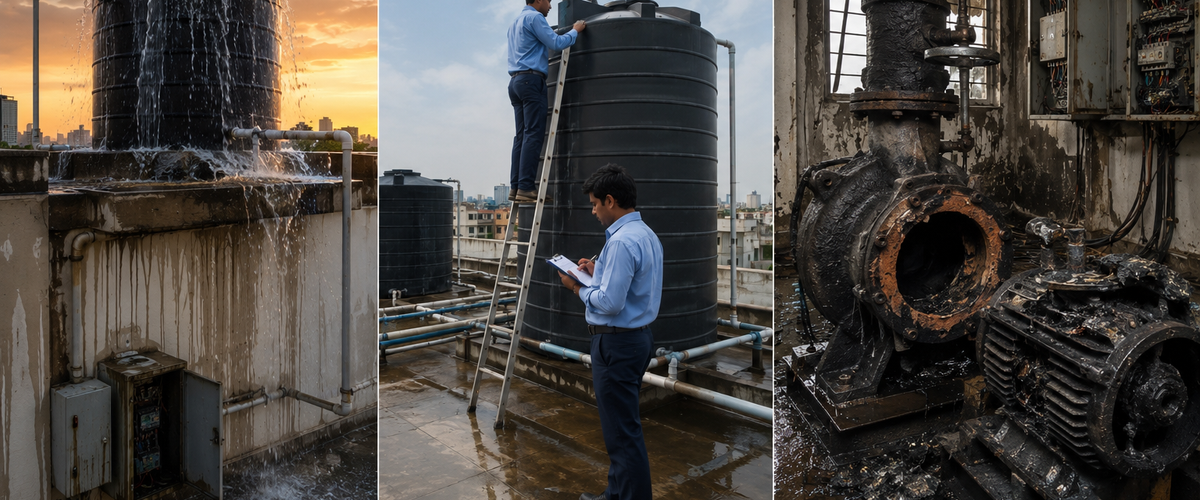
Stop managing emergencies and start managing efficiency with MyTank
Water is often treated as a fixed utility cost - something you pay for, use, and rarely think about until it stops running. But if your facility or commercial property still relies on a manual approach to manage its water supply, you are losing money every single hour.
Most operations managers only calculate the visible expenses: the monthly water bill and the occasional maintenance invoice. The reality? Relying on a team member to flip a switch, check a visual gauge, or listen for an overflowing tank carries massive, invisible overheads.
Here are the 5 hidden costs of manual water tank management - and how moving toward smart water management turns an operational headache into a profit center
1. The Cost of Overflow-Related Property Damage
When a tank overflows, the loss isn't just the physical water pouring over the edge. Repeated overflows weaken concrete roof slabs, rust structural beams, destroy ceiling tiles, and foster mold. If a major overflow migrates into electrical shafts, it can trigger short circuits and catastrophic facility downtime. Without real-time visibility, water continues to pump until someone physically notices the flood.
2. Premature Pump Burnouts and Dry Run Failures
Pumps are expensive assets, and manual operation strips years off their lifespan. When a pump runs manually, it is highly susceptible to two silent killers:
- Dry Running: Operating the pump when the underground source sump is empty, causing immediate overheating and motor seizure.
- Overload / low voltage: Manual setups leave your heavy-duty motors completely defenseless against unexpected phase faults or voltage spikes.
3. Ballooning Energy Bills from Inefficient Pump Runtimes
Manual water operations can inflate your energy consumption by up to 45%. When human intervention controls start-and-stop actions, pumps are frequently left running long after a tank has filled, drawing maximum power for zero operational gain. Furthermore, manual setups rarely take advantage of off-peak electricity tariffs.
4. Heavy Labor Drain and Human Error
How much are you paying staff to simply walk up flights of stairs, scale ladders, check levels, and manually throw switches? When your team is locked into a cycle of reactive manual checks, they aren't focusing on preventative maintenance. Even worse, human error is inevitable. A single missed shift or a forgotten valve adjustment means empty overhead tanks and interrupted operations.
5. Blind Spots and Missing Data
In a manual water setup, a hairline fracture in an underground pipeline can leak thousands of gallons a day completely undetected. Because there is no historical tracking of water data or consumption patterns, these micro-losses remain invisible until you get hit with an inexplicably massive utility bill at the end of the month.

The Solution: Total Wireless Tank Automation with the MyTank App
The friction, risks, and bleeding capital of manual operations disappear the moment you inject intelligence into your framework. With a best wireless water tank monitoring system, you shift from reactive firefighting to predictive, hands-off efficiency.
1. Millimeter-Accurate Visibility
Deploy a non-invasive wireless tank level sensor with 1 mm measurement resolution to track liquid levels with exceptional accuracy. Self-powered, No drilling, cabling, or structural modifications are required, while real-time level data and depth analytics are streamed directly to your cloud dashboard.
2. Intelligent Motor Protection
Pair your tank level sensors with a smart automatic wireless pump controller featuring Wi-Fi/4G connectivity to protect critical equipment. The controller monitors pump status and electrical parameters in real time, automatically tripping during dry-run conditions, overloads, voltage fluctuations, and phase failures. All alerts and pump data are instantly available on the cloud for remote monitoring and control.
3. Flawless Long-Range Communication
A robust wireless pump controller bridges the physical gap between your sump and your roof. The water tank level sensor safely talks to your smart starters, turning the pump on and off automatically without requiring a single footstep from your team.
4. Global Control via a Single Dashboard
Whether you run a single building or oversee an entire regional enterprise, our smart water management ecosystem is built to scale. From the centralized MyTank App, you can:
- Monitor multi-site tanks—oversee thousands of tanks across different properties inside a single, unified dashboard.
- Utilize full remote pump control to turn pumps on or off from anywhere in the world.
Stop Paying for Inefficiency
Transitioning to an automated ecosystem yields an average 30% reduction in water waste, eliminates premature pump failures, and slashes labor overhead. With a typical operational payback period of just 6 months, the question isn't whether you can afford to automate - it's how much manual management is costing you every day you wait.
Ready to eliminate the hidden costs of manual water management?
Explore the full range of plug-and-play smart water management solutions and take complete control of your facility's footprint via the MyTank App.
Schedule a CallFrequently Asked Questions
How does a wireless tank level sensor communicate over long distances?
The MyTank wireless tank level sensor uses long-range, industrial-grade wireless protocols (like LoRa) that can securely transmit water depth analytics across distances up to 5km. This completely eliminates the need for expensive structural cabling between your reservoirs, sumps, and roof tanks.
Can the automatic pump controller protect my motor from burning out?
Yes. The automatic pump controller features built-in digital intelligence that tracks real-time voltage and current metrics. If it detects a dry run scenario (empty source sump) or electrical anomalies like high/low voltage and phase faults, it instantly trips the pump to prevent permanent motor damage.
What is the best water tank level sensor for commercial facilities?
The best option is a non-invasive, solar powered , industrial-grade wireless tank level sensor using radar technology. Unlike mechanical float switches that rust and jam, radar sensors offer millimeter-accurate tracking without touching the water, feeding live depth analytics directly to the cloud.
Why should businesses use smart water management instead of manual checks?
Businesses switch to automated smart water management to eliminate human error, prevent costly property overflows, and stop dry run pump failures. Moving to an automated ecosystem cuts water waste by up to 30% and slashes unnecessary pump electricity runtimes by up to 45%.
Is there a reliable tank level sensor for specialized applications like multi-site tracking?
Yes. Modern IoT setups are designed specifically to monitor multi-site tanks, allowing you to oversee thousands of tanks across multiple properties in a single dashboard. Through the MyTank app, you get instant remote pump control and customized schedule access for any enterprise or utility application from anywhere in the world.