The Role of IoT Water Tank Monitoring in WASH Programs
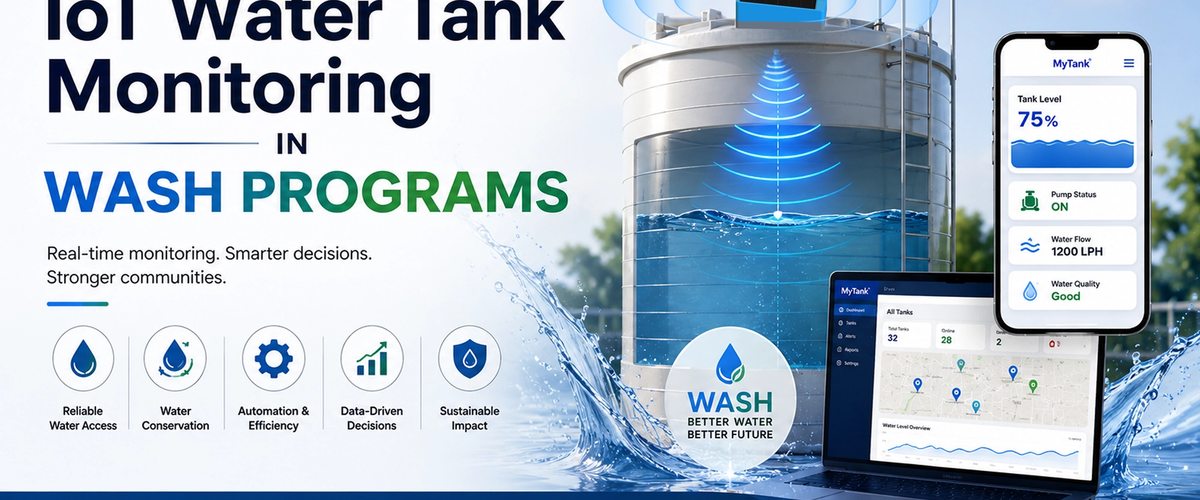
IoT water tank monitoring system with radar water level sensors
Access to safe water is only one part of a successful WASH (Water, Sanitation and Hygiene) program. Equally important is ensuring that water is available, monitored, distributed efficiently, and protected from wastage every day.
Many schools, hospitals, villages, apartment communities, and public institutions participating in WASH initiatives still depend on manual inspection of storage tanks. Operators often climb tanks to check water levels, switch pumps on and off manually, and discover leaks or overflows only after significant water has already been lost.
As WASH programs continue expanding worldwide, manual water management is becoming increasingly difficult to sustain. This is where IoT water tank monitoring system play a vital role by providing real-time visibility, automation, and data-driven decision-making.
Why Water Tank Monitoring Matters in WASH Programs
Every WASH project relies on one fundamental requirement:
Reliable water availability at the right place and at the right time.
Without continuous monitoring, organizations commonly face:
- Water tank overflows
- Dry tanks during peak demand
- Manual pump operation
- Undetected leaks
- Inconsistent water distribution
- High maintenance costs
- Lack of operational data
These challenges directly affect sanitation facilities, drinking water availability, and overall service reliability.
Smart water tank monitoring eliminates these uncertainties by providing continuous visibility into the entire water infrastructure.
What Is IoT Water Tank Monitoring?
An IoT water tank monitoring system uses intelligent sensors, wireless communication, cloud software, and mobile applications to continuously monitor water storage tanks.
Instead of periodic manual inspections, the system automatically reports:
- Water level
- Tank status
- Pump operation
- Water flow
- Water quality (where required)
- System alerts
- Historical trends
Authorized users can monitor every tank remotely from a web dashboard or mobile application, enabling faster decisions and reducing operational effort.
How IoT Supports WASH Objectives
Ensures Continuous Water Availability
Schools, healthcare facilities, and community water systems cannot afford empty tanks.
Real-time tank monitoring enables operators to:
- Know available water at all times
- Receive low-level alerts
- Schedule refilling proactively
- Avoid unexpected service interruptions
Continuous visibility improves reliability across WASH infrastructure.
Prevents Water Overflow and Wastage
Overflowing tanks waste thousands of liters of treated water every year.
An IoT monitoring system detects rising water levels and can automatically stop pumps before overflow occurs.
Benefits include:
- Water conservation
- Lower operating costs
- Reduced energy consumption
- Less infrastructure damage
Automates Pump Operations
Manual pump operation is one of the most common causes of inefficient water management.
Using predefined level thresholds, IoT systems automatically:
- Start pumps
- Stop pumps
- Protect against dry running / over voltage
- Balance storage between multiple tanks
This reduces human intervention while ensuring uninterrupted water supply.
Improves Water Distribution
Large WASH projects often manage multiple storage tanks across different locations.
Real-time monitoring helps operators:
- Compare storage levels
- Optimize water distribution
- Prioritize critical facilities
- Respond quickly during shortages
Instead of reactive management, utilities can make proactive operational decisions.
Supports Better Maintenance
Rather than waiting for complaints, maintenance teams receive instant alerts when abnormalities occur.
Examples include:
- Overflow events
- Low tank levels
- Pump failures
- Communication loss
- Sensor anomalies
Early detection reduces downtime and maintenance costs.
Why Radar Water Level Sensors Are Ideal for WASH Projects
The performance of any monitoring system depends on the sensing technology.
Modern WASH projects increasingly prefer non-contact radar level sensors because they offer reliable measurement without touching the water.
Compared to traditional float switches or contact sensors, radar sensors provide:
- High measurement accuracy
- Solar-powered, self-energy harvesting
- Non-contact operation
- No moving parts
- Minimal maintenance
- Reliable performance in humid environments
- Suitable for overhead, underground, and open tanks
Since the sensor never contacts the water, it also reduces contamination risks and maintenance requirements - important considerations for drinking water applications.
Beyond Tank Levels: Building a Smart Water Infrastructure
Modern WASH programs require more than knowing whether a tank is full or empty.
A complete IoT platform can integrate:
- Tank Level Monitoring
- Automatic Pump Control
- Remote Valve Automation
- Water Flow Monitoring
- Water Quality Monitoring
- Cloud Dashboards
- Mobile Notifications
- Historical Analytics
- Multi-site Monitoring
Together, these capabilities provide complete visibility over water infrastructure and support data-driven operations.
How My Tank Supports Smart WASH Infrastructure
As WASH projects expand across schools, hospitals, industries, municipalities, and community water systems, operators need a platform that simplifies monitoring while improving operational efficiency.
My Tank is an IoT-based water monitoring and automation platform designed to help organizations manage their water infrastructure from a single dashboard.
The platform supports:
- Real-time water tank level monitoring
- Wireless radar water level sensors
- Automatic pump control
- Remote valve automation
- Water flow monitoring
- Water quality monitoring
- Instant alerts and notifications
- Cloud dashboard with mobile access
- Multi-location monitoring
Its wireless architecture enables faster deployment with minimal site disruption, making it suitable for both new and existing WASH infrastructure.
Future of WASH Is Data-Driven
The future of WASH is not just about providing water - it is about managing water intelligently.
By combining IoT, automation, cloud platforms, and radar sensing technology, organizations can:
- Improve water availability
- Reduce non-revenue water
- Minimize manual inspections
- Increase operational efficiency
- Support sustainable water management
- Deliver better services to communities
As governments, municipalities, educational institutions, and industries invest in smarter infrastructure, IoT water tank monitoring will become an essential component of modern WASH programs.
Build a future-ready WASH infrastructure with My Tank
Monitor every tank, automate every pump, and manage your entire water network from one intelligent cloud platform.
Schedule a CallFrequently Asked Questions
What is WASH?
WASH stands for Water, Sanitation and Hygiene. It refers to programs and initiatives that improve access to safe water, sanitation facilities, and hygiene practices in communities, schools, healthcare facilities, and public institutions.
How does IoT help WASH programs?
IoT enables real-time monitoring of water tanks, pumps, flow, and water quality. It helps reduce water wastage, automate operations, improve maintenance, and ensure reliable water availability.
Why are radar water level sensors preferred?
Radar level sensors measure water levels without contacting the water. They offer high accuracy, require minimal maintenance, and perform reliably in harsh environmental conditions, making them well suited for WASH infrastructure.
Can IoT water tank monitoring work for multiple locations?
Yes. My Tank smart water management solution supports monitor hundreds of water tanks across different locations from a single dashboard, allowing centralized management and faster response to operational issues.