How to Prevent Water Tank Overflow Using a Water Level Sensor
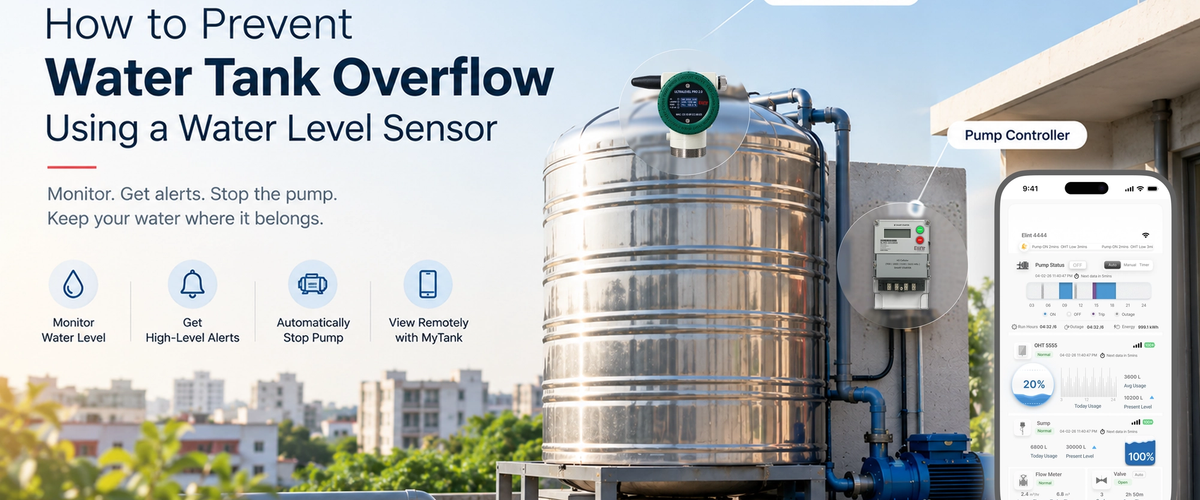
How Tank Level Sensor Prevent Water Overflow
Water tank overflow is a common problem in homes, apartments, commercial buildings, and industrial facilities. It often happens when a pump continues running after the tank is full or when nobody notices that the water has reached its maximum level.
This leads to water wastage, unnecessary pump operation, higher electricity consumption, and avoidable maintenance.
A tank level sensor helps prevent overflow by monitoring how much water is in a tank. When connected to a compatible pump controller, it can trigger an alert or automatically stop the pump when the water reaches a predefined level.
In this guide, we explain how overflow prevention works, what to consider when choosing a sensor, and how My Tank helps make water management easier.
Why Does Water Tank Overflow Happen?
Tank overflow usually occurs when water continues entering a tank after it has reached its required level.
Some common reasons include:
- Manual pump operation: Someone forgets to switch off the pump.
- No high-level alert: There is no reliable indication that the tank is full.
- Faulty controls: A damaged float switch or incorrectly configured controller fails to stop the pump.
- Delayed monitoring: The overflow is noticed only after water has already been wasted.
- Multiple tanks: Managing several overhead tanks and underground sumps manually becomes difficult.
These challenges are particularly common in apartments, campuses, hospitals, hotels, and commercial buildings where multiple tanks need regular monitoring.
An automated monitoring system helps operators understand tank conditions and respond before overflow occurs.
How Does a Tank Level Sensor Prevent Tank Overflow?
Preventing overflow involves three steps: measuring the water level, identifying when the tank is nearly full, and stopping the water supply at the right time.
Monitor the water level
A sensor detects or measures the water level in the tank. Depending on the technology, it may provide continuous readings or indicate when the water reaches a specific point.
For example, a radar level sensor mounted above a tank measures the distance to the water surface. The system uses this measurement to determine the current level.
Set a maximum water level
The system uses a configured high-level limit to determine when action is needed.
This limit should be set below the actual overflow point, allowing enough time for the pump to stop and for water already moving through the inlet pipe to enter the tank.
Stop the pump automatically
When the water reaches the configured limit, a compatible controller can switch off the pump. Depending on the system, an alert can also notify the operator.
This reduces reliance on manual checks and helps prevent water from spilling out of the tank.
Important: A sensor alone does not necessarily stop the pump. Automatic overflow prevention requires compatible control equipment, correctly configured settings, and a tested switching arrangement.
Which Sensor Is Suitable for Water Tank Overflow Prevention?
Different technologies suit different tanks and operating conditions. The right choice depends on the required accuracy, installation environment, tank depth, and control method.
Float switches
A float switch changes its electrical state when the water reaches a particular level. It is often used for basic high-level detection and pump control.
It can be a practical choice when only a simple switching point is required. However, it does not usually provide continuous information about how full the tank is.
Ultrasonic sensors
An ultrasonic sensor measures the distance to the water surface using sound waves. The system converts this distance into a water level reading.
It provides non-contact measurement, although condensation, obstructions, and installation conditions can affect performance.
Radar sensors
A radar tank level sensor measures the distance to the water surface using electromagnetic waves. Since it does not need to touch the water, it can be useful for overhead tanks and other storage applications where contactless measurement is preferred.
Depending on the model and system configuration, readings can be sent wirelessly to a monitoring platform for remote visibility, alerts, and pump automation.
Hydrostatic sensors
A hydrostatic level sensor measures pressure associated with the water column to determine the level. It can be suitable for underground sumps, borewells, and other installations where measurement from the top of the tank is not practical.
The sensor must be selected according to the tank depth, liquid properties, mounting arrangement, and operating conditions.
What Should You Consider Before Choosing a Sensor?
The right equipment should do more than detect a full tank. It should fit your installation and work reliably with the rest of your water management system.
Tank type and depth
Identify whether you need to monitor an overhead tank, underground sump, concrete reservoir, or industrial storage tank.
Check the tank depth and the usable measurement range of the selected device. For radar sensors, also account for the minimum measuring distance and any blind zone.
Basic switching or continuous monitoring
If your only requirement is to stop the pump at a fixed level, a suitable float switch may be enough.
If you need to view the current water level, track changes over time, receive alerts, or monitor multiple tanks, a continuous measurement sensor may be more suitable.
Wired or wireless communication
A wired device may be appropriate when a control panel or PLC is nearby and cabling is practical.
Wireless options can simplify installations where tanks are spread across a building or campus. Depending on the selected equipment, connectivity may include LoRaWAN, 4G, Wi-Fi, or other supported technologies.
For remote installations, check network coverage, power requirements, and whether a gateway is needed.
Pump controller compatibility
Confirm that the sensor and controller can work together. Check the available outputs, electrical requirements, switching arrangement, and control logic before installation.
The system should also be tested to ensure the pump stops correctly when the high-level limit is reached.
Alerts and remote access
For facilities with several tanks, a centralized dashboard can help operators check water levels without visiting each location.
Useful functions include high-level alerts, historical readings, pump status, and access to tank information from a mobile phone or computer.
How My Tank Helps Prevent Water Tank Overflow
My Tank is a wireless water management solution from Elint Systems that combines water level monitoring with compatible pump automation.
Instead of depending entirely on manual inspections, users can monitor supported tanks and manage water operations through a connected platform.
Wireless water level monitoring
My Tank supports wireless monitoring using its wireless radar level sensor . The appropriate model depends on the tank, required measuring range, power source, and connectivity needs.
The contactless measurement approach can be useful for overhead water tanks where installing a sensor inside the water is undesirable.
Remote visibility
Users can view water level readings through the My Tank platform, helping them understand tank conditions without repeatedly visiting the installation.
This is particularly useful for apartment buildings, campuses, hotels, and commercial facilities with multiple storage tanks.
Alerts when attention is needed
Configured alerts can help operators identify high water levels and respond promptly. This makes it easier to identify situations that require intervention.
Automatic pump control
When a compatible sensor is integrated with a suitable automatic pump controller, the system can stop the pump when the tank reaches its configured high-level limit.
This helps reduce dependence on manual switching and supports more consistent water management.
Monitoring multiple tanks
My Tank can bring readings from supported tanks into a centralized platform, depending on the selected equipment and system configuration.
Operators can use this visibility to check tank conditions, identify potential issues, and manage water operations more efficiently.
The overall setup should be selected according to the number of tanks, installation layout, connectivity, and automation requirements
Conclusion
Water tank overflow can often be prevented by combining reliable level measurement with timely action.
A suitable sensor identifies when the tank is approaching its maximum level, while a compatible controller can stop the pump automatically. Remote monitoring and alerts provide additional visibility, particularly in buildings with multiple tanks.
For installations that require continuous readings and remote access, a wireless radar sensor can be part of a broader monitoring and automation solution.
My Tank brings wireless water level monitoring, alerts, and compatible pump control together to help residential, commercial, and industrial facilities manage their water systems more efficiently.
Frequently Asked Questions
How can I prevent a water tank from overflowing?
Use a suitable sensor with a compatible pump controller. Configure a high-level limit so the pump stops before the tank overflows, and test the system to confirm that it operates correctly.
Which sensor is best for preventing tank overflow?
The best option depends on your requirements. A float switch may be suitable for simple on/off control, while a radar sensor can provide continuous, non-contact measurement for monitoring and automation.
Can a water level sensor switch off a pump automatically?
Yes, when it is connected to compatible control equipment with the correct settings. The sensor measures or detects the level, and the controller performs the switching.
Can I monitor my water tank from my mobile phone?
Yes. With a compatible wireless sensor and monitoring platform, you can view tank readings remotely. Alerts and pump status may also be available, depending on the system configuration.