How pump automation reduces electricity bills in high-rise buildings

A smart pump controller with a wireless tank level sensor eliminates all three — automatically. Start at 20% tank level, stop at 95%, never overflow, never dry run.
In most high-rise buildings, the water pump is the single biggest consumer of common-area electricity - quietly inflating maintenance bills every month. The fix isn't a bigger budget. It's smarter control.
The pump problem nobody talks about
Ask any RWA treasurer where electricity costs are highest - they'll guess lighting or lifts. The answer is almost always pumps. In a typical 80-unit apartment complex, a 5 HP motor running manually can account for 40–50% of common electricity consumption.
The waste isn't in the pump itself. It's in how it's operated - overflows when no one turns it off in time, dry runs when the sump is empty, and unnecessary cycles because nobody checked the tank level first.
Where the electricity is actually going
1. Overflow losses
When the tank is full but the pump keeps running, every extra liter pumped is electricity spent on water you'll spill. Without a wireless tank level sensor closing the loop automatically, this happens every single day.
2. Dry runs
A pump running without water draws full power while moving nothing - and damages the motor. Without a pump protection device watching the sump level, each dry run is invisible until the motor fails.
3. Wrong timing
Manual operation means pumps run whenever someone flips a switch - often during peak tariff hours. Shifting to off-peak slots alone can cut the effective cost per unit by 30–40%.
4. Redundant cycles
Without level visibility, staff top up tanks "just to be safe" - pumping into tanks already 75% full. Every unnecessary cycle costs money without adding usable water.
The pump controller: where automation begins
At the heart of any smart water system is the pump controller - the device that decides when the motor starts, when it stops, and whether it's safe to run at all. MyTank's Smart Starters serve as intelligent pump controllers that go far beyond a basic on/off relay.
Buildings run two motor types, and each needs a different controller:
Single-phase pump controller
For domestic sumps and smaller overhead tank setups. Single-phase pump controller monitors voltage, current, power factor, and run hours - with remote on/off via the MyTank app.

Three-phase pump controller
For high-rise transfer pumps and industrial setups. Three-phase pump controller handles heavy motor loads with DOL or star delta , phase fault detection, overload protection, and full remote control.
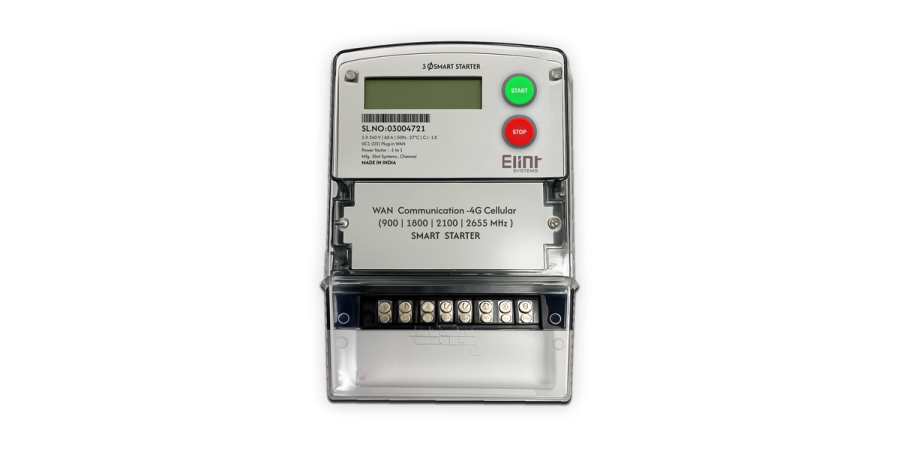
Both controllers connect wirelessly via LoRa to the cloud, feeding live data into the MyTank water level management app - so you always know what your motor is doing, and what it costs.
Pump health monitoring: knowing before it breaks
One of the most undervalued benefits of a smart pump controller is continuous pump health monitoring. Instead of discovering a problem after the motor trips or fails, the system tracks performance metrics in real time:
- Live voltage, current, and power factor readings flag motor stress early
- Energy consumption per run cycle reveals efficiency drift over time
- Cumulative run hours track motor age and guide servicing schedules
- Abnormal current draws signal bearing wear or cavitation before they cause failure
A motor that takes 20% longer to fill the tank than it did six months ago is telling you something. Pump health monitoring makes that signal visible -before it becomes a ₹20,000 repair bill.
Built-in pump protection - automatic, always on
The MyTank Smart Starter doubles as a pump protection device, with hardware-level safeguards that activate instantly - no manual intervention needed:
- Dry run protection
- Overload cutoff
- Voltage spike guard
- Phase fault detection
- Low pressure trip
- Auto restart logic
These protections extend motor lifespan significantly. In buildings where motors previously needed replacement every 3–4 years due to recurring dry runs and voltage damage, automated protection routinely pushes that to 7–10 years.
The wireless tank level sensor: closing the loop
A pump controller is only as smart as the data it receives. That's where the wireless tank level sensor becomes the critical piece of the system.
MyTank's wireless radar-based sensors (UltraLevel Pro 2.0 and UltraLevel Max) mount on the overhead tank lid - no tank modification, no cabling, no external power , no civil work. They measure the actual water surface continuously, accurate to 1 mm, across a range of 5 cm to 22 metres.
The sensor transmits over LoRa - up to 5 km - to the gateway. The pump controller receives the level signal and acts on it: start filling at 20%, stop at 95%, never overflow, never dry run. The sump level sensor at the bottom of the system completes the circuit, preventing the motor from starting when there's nothing to pump.
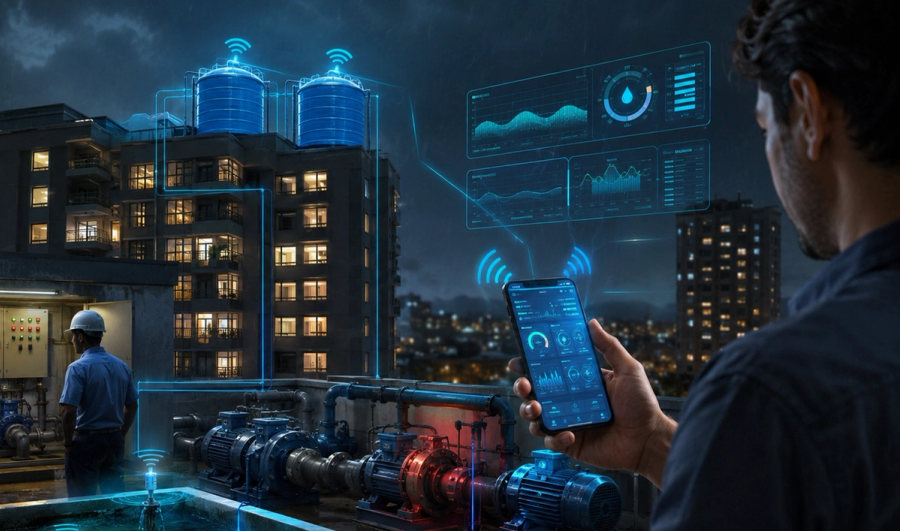
Together, the wireless tank level sensor and the pump controller form a closed-loop system - one monitors the water, the other controls the motor, and both talk to each other without a single wire between them.
How quickly can you get started?
- MyTank assesses your building layout, motor type (single or three phase), and tank positions
- Wireless tank level sensors mount on OHT lids; pump controllers connect to existing motor panels — no drilling, no civil work
- Level thresholds, protection settings, and alert preferences are configured via the MyTank app
- From day 4, your water system runs automatically with full pump health monitoring on your phone
Ready to Automate Your Pump Systems
Most buildings recover the investment within 6 months. After that, every rupee saved by the system is pure gain - month after month, without any ongoing manual effort.
Get a free consultationFrequently Asked Questions
What is a pump controller and how does it automate a water tank?
A pump controller automatically starts your motor when the tank is low and stops it when full - using live data from a wireless tank level sensor. It removes manual switching entirely and protects the motor from dry runs and overloads, all controllable via the MyTank app.
What is the difference between single phase and three phase pump controller?
Suitable for homes, apartments, high-rise, and commercial buildings, the smart pump controller supports Single Phase and Three Phase Star Delta / DOL starters with real-time energy monitoring, remote control, dry run protection, overvoltage protection, overload safety, and phase reversal detection for reliable automated pump operation.
How does pump health monitoring prevent motor failure?
It tracks live current, voltage, and run hours - alerting you when readings drift from normal before a breakdown occurs. This shifts maintenance from reactive to predictive, typically doubling motor lifespan and avoiding costly emergency repairs.
What does pump protection device guard against?
It auto-trips the motor on dry run, overload, voltage spike, phase fault, or pipeline pressure anomaly — instantly, without manual intervention. MyTank's Smart Starter runs all six protections 24/7, preventing motor damage that typically costs ₹8,000–₹25,000 per repair.
How quickly does a water tank automation system pay for itself?
Most buildings recover the investment within 6 months - through lower electricity bills, reduced water waste, and avoided motor repairs. After that, every saving is pure gain. Get a free consultation to see the numbers for your building.