How Chennai Apartments Can Automate OHT and Sump Water Management
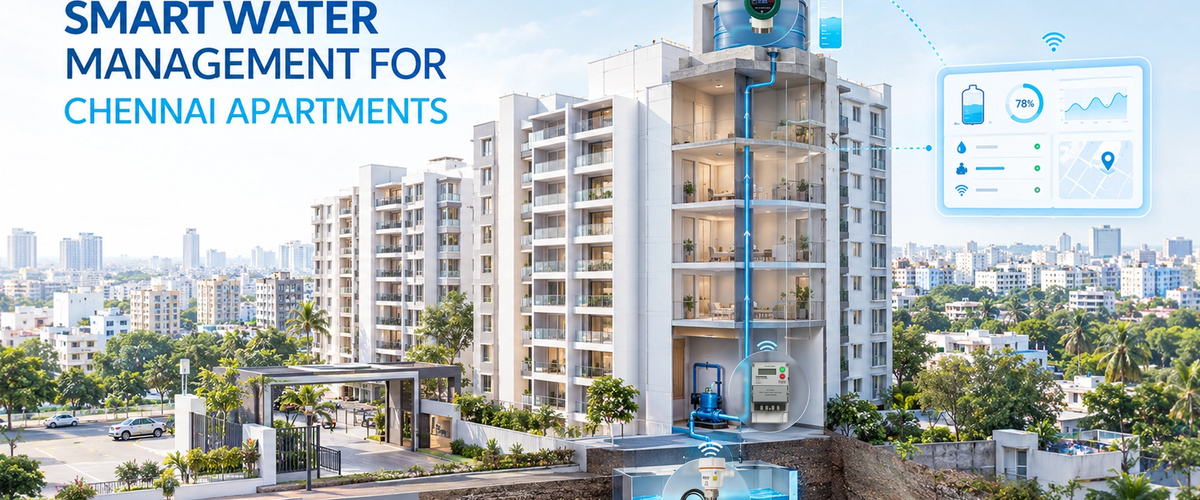
Smart Water Management Platform for chennai apartments
In a large apartment community, water management is more than simply knowing whether a tank is full or empty. Underground sumps, overhead tanks, pumps and pipelines all need to work together to maintain a reliable water supply.
Yet many apartment communities still depend on security staff or maintenance teams to manually check tank levels and operate pumps.
This can lead to overflowing OHTs, low sump levels, unnecessary pump operation and delayed response when something goes wrong.
A smarter approach is to connect the entire water system.
With smart water tank monitoring in Chennai, apartment communities can monitor sump and OHT levels remotely, automate pump operation and receive alerts when attention is required.
The Water Management Challenge in Chennai Apartments
Apartment communities typically have multiple water storage and pumping points:
- Underground sump for incoming or stored water
- Transfer pumps
- Overhead tanks (OHTs)
- Distribution pipelines
- Multiple apartment blocks
- Borewell or other water sources in some properties
The challenge is not only storing water. It is coordinating these points efficiently.
A maintenance team may need to know:
- Is the sump filling?
- Is there enough water for pumping?
- Is the OHT getting low?Is the pump running?
- Has the OHT reached its required level?
When these checks depend entirely on manual inspection, problems can easily be missed.
From Manual Checking to Smart Monitoring
A modern wireless radar level sensor can continuously measure water levels in connected tanks and transmit the data to a centralized monitoring dashboard. This allows apartment facility teams to remotely monitor sump and OHT levels without relying on frequent manual inspections.
For an apartment community, this can mean:
- Real-time sump level monitoring
- OHT level monitoring
- Pump automation
- Low and high-level alerts
- Remote access through mobile or web
- Historical water-level data
- Automated pump operation
Instead of waiting for someone to physically inspect each tank, facility teams can see the condition of the water system remotely.
How Sump and OHT Automation Works
A water level sensor monitors the sump while another monitors the OHT. The automatic pump controller uses this information to operate the transfer pump according to configured conditions.
For example:
OHT level LOW OR pressure HIGH → PUMP ON
OHT level HIGH OR water/pressure condition LOW → PUMP OFF
This allows the pump to respond to actual water-system conditions rather than relying on fixed manual schedules.
With an IoT-connected system, the same operating information can also be viewed remotely.
OHT Level Monitoring for Apartment Communities
An OHT level monitoring system provides continuous visibility into the amount of water available for distribution.
A wireless radar level sensor installed above the tank can measure the water level without being submerged. My Tank's UltraLevel pro 2.0 uses non-contact radar sensing and wireless communication for remote tank monitoring. The platform supports multi-tank monitoring and can connect tank-level data to a mobile or cloud dashboard.
This is particularly useful when an apartment has:
- Multiple OHTs
- Tanks located on different blocks
- Difficult-to-access rooftops
- Multiple pumps
- Separate water storage zones
Instead of checking every tank individually, facility teams can view the connected tanks from one platform.
Sump Monitoring: Know When Water Is Available
Monitoring the OHT alone is not enough.
If the sump becomes empty while the transfer pump continues operating, the pump can be exposed to dry-run conditions.
A hydrostatic sump level sensor provides visibility into the available water before the pump operates.
The monitoring system can track:
Sump level → Pump condition → OHT level
This creates a more complete picture of the water-transfer process and allows automation logic to respond to both source and destination conditions.
My Tank supports sump-level monitoring alongside OHT monitoring and pump automation as part of its connected water-management platform.
Wireless Installation Without Extensive Cabling
Retrofitting water monitoring into an existing apartment can be difficult when new communication cables have to be routed between rooftops, pump rooms and different buildings.
A wireless architecture can simplify this process.
My Tank uses wireless communication for tank-level monitoring, with LoRa-based field connectivity and 4G/Wi-Fi connectivity for cloud access. Depending on the deployment, its wireless architecture can support communication over distances of up to 5 km.
This makes wireless monitoring useful for apartment communities where tanks and pumps are distributed across multiple buildings.
Automatic Pump Control Instead of Manual Operation
Monitoring tells the maintenance team what is happening.
Automation can take the next step.
A smart wireless pump controller can receive level and operating-condition information and control the pump automatically. My Tank's pump automation supports automatic, manual and timer operating modes, while its controllers can also incorporate protection functions such as dry-run, overload and voltage-related protection depending on the model.
This can reduce routine manual intervention while giving facility teams remote visibility and control when required.
One Dashboard for the Entire Apartment Water System
The real advantage comes when individual devices work as one connected system.
An apartment community can bring together:
Sump | Pumps | OHT | Flow | Valves | Water Quality
Instead of managing these systems independently, facility teams can monitor them through a unified platform.
My Tank's platform is designed to bring tank levels, pump status, flow, valves and water-quality information into one connected water-management ecosystem.
This creates a clearer operational picture and makes it easier to identify abnormal conditions before they become larger problems.
Chennai Today. Bengaluru and Other Cities Next.
The same apartment water-management challenges are not limited to Chennai.
Large residential communities in Bengaluru also manage multiple water sources, sumps, OHTs, pumps and storage points. A connected system can provide centralized visibility of these assets and help facility teams manage water infrastructure more efficiently.
For communities exploring smart water management in Bengaluru, the same approach can be applied:
Monitor → Automate → Alert → Analyze
The architecture can be adapted to the number of tanks, pumps, buildings and water sources at each property.
This makes wireless IoT water monitoring suitable for apartment communities across Chennai, Bengaluru and other growing cities.
Why Smart Water Tank Monitoring Matters
For an apartment community, the objective is not simply to install another sensor.
The objective is to make the water system easier to operate.
A connected monitoring and automation system can help communities:
- Reduce manual tank inspections
- Prevent avoidable overflow
- Reduce unnecessary pump operation
- Identify low-water conditions earlier
- Monitor multiple tanks remotely
- Improve pump protection
- Maintain better visibility of daily water operations
The result is a more connected and manageable water infrastructure.
How My Tank Automates Apartment Water Management
My Tank combines wireless water-level monitoring, pump automation and remote visibility into one platform.
For apartment communities, the system can connect:
- OHT Level MonitoringReal-time visibility of overhead tank levels
- Sump Level MonitoringContinuous monitoring of underground water availability
- Wireless Pump AutomationAutomatic pump operation based on configured conditions
- Remote MonitoringMobile and cloud access to tank and pump status
- Alerts & InsightsNotifications for important water-system events
- Multi-Tank ManagementMonitor multiple tanks from a centralized platform
With wireless radar level sensors, smart pump controllers, and connected monitoring, an apartment's water infrastructure can move from manual operation toward a more automated system.
Conclusion
For modern apartment communities, reliable water management requires more than manually checking tanks and switching pumps ON and OFF.
A connected system can bring sump monitoring, OHT monitoring, pump automation, and remote visibility together as one water-management workflow.
Whether the requirement is smart water tank monitoring in Chennai, IoT-based water monitoring in Bengaluru, or a multi-building water-management system, the principle remains the same:
Know your water. Automate your pumps. Manage every tank from anywhere.
Make Your Apartment Water System Smarter
Move from manual tank checks to connected water monitoring and pump automation with My Tank.
Schedule a CallFrequently Asked Questions
How does smart water tank monitoring work in an apartment?
Smart level sensors continuously measure water levels in sumps and OHTs. The data is transmitted wirelessly to a monitoring platform where users can view levels, receive alerts and, when connected to a smart pump controller, automate pump operation.
Can OHT and sump levels be monitored together?
Yes. A connected water-management system can monitor multiple OHTs and sumps from a centralized dashboard, allowing facility teams to understand the relationship between water availability, pumping and storage.
Can water tanks be monitored without communication cabling?
Yes. Wireless tank-level monitoring can reduce the need for long communication cables between tanks and controllers. MyTank uses wireless connectivity options including LoRa/LoRaWAN and cellular or Wi-Fi backhaul depending on the deployment.
Is this suitable for apartments in Bengaluru as well as Chennai?
Yes. The same monitoring and automation architecture can be adapted for apartment communities in Bengaluru and other cities, depending on the number of tanks, pumps, buildings and water sources.
Can residents monitor the water system from a mobile phone?
With an IoT-enabled platform, authorized facility teams can monitor tank levels, pump status, alerts and other connected water-system information remotely through a mobile or web interface.