How Radar Level Sensors Work for Overhead Tank Monitoring (OHT)
Radar level sensors work for overhead tank monitoring
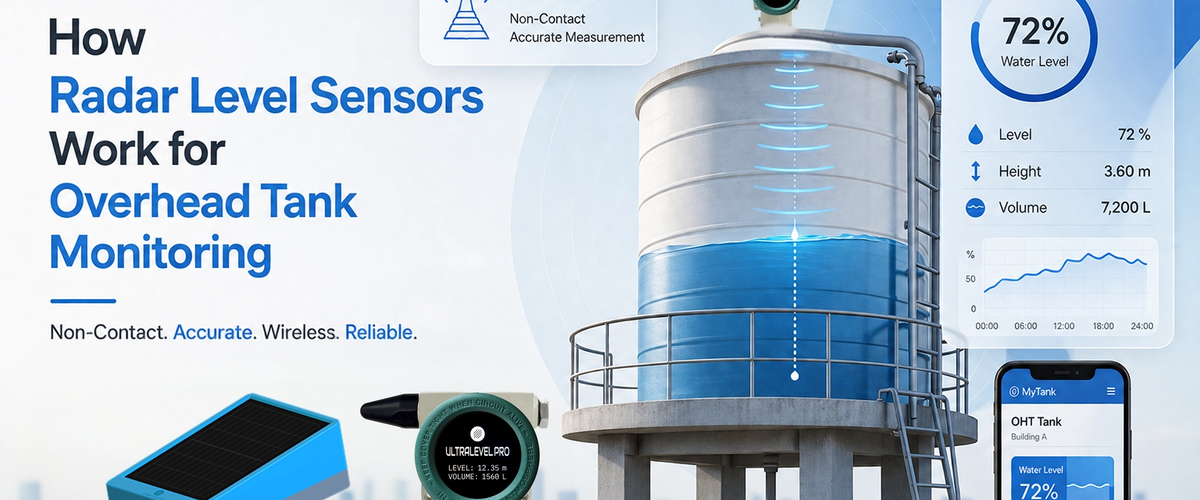
Water management has evolved beyond manually climbing rooftops to check tank levels. Today, a wireless radar level sensor provides accurate, real-time water level monitoring without touching the water, making it one of the most reliable technologies for overhead tank monitoring.
Whether you're managing a residential apartment, villa, commercial building, hospital, factory, or municipal water storage system, knowing the exact water level helps prevent overflow, avoid dry-running pumps, and improve operational efficiency.
In this guide, you'll learn how a radar water level sensor works, why it is better than conventional sensors, and how it integrates with modern IoT water tank monitoring systems.
New to level sensing? Before exploring radar technology, read our complete guide on Water Tank Level Sensors to understand the different types of sensors used for water tank monitoring.
What Is a Radar Water Level Sensor?
A radar water level sensor is a non-contact water level sensor that measures the distance between the sensor and the water surface using high-frequency microwave signals.
Unlike float switches or probe-based sensors, a radar sensor is installed at the top of the overhead tank. Since it never comes into contact with water, it delivers highly reliable measurements with minimal maintenance.
Modern wireless radar level sensors also support IoT connectivity, enabling users to monitor water levels remotely through cloud dashboards and mobile applications.
How Does a Radar Level Sensor Work?
The working principle is based on Time of Flight (ToF) technology.
1. The Sensor Transmits Radar Waves
The radar sensor continuously emits microwave signals toward the surface of the water.
2. The Water Reflects the Signal
Once the radar wave reaches the water surface, it is reflected back toward the sensor.
3. The Distance Is Calculated
The sensor measures how long the radar signal takes to return. Since radio waves travel at a known speed, the sensor accurately calculates the distance between itself and the water.
4. Water Level Is Determined
The measured distance is subtracted from the tank height to determine the actual water level inside the tank.
The entire process happens within milliseconds and repeats continuously, providing real-time water level updates.
Why Wireless Radar Level Sensors Are Becoming the Preferred Choice
Building owners and facility managers are replacing traditional water level sensors with wireless radar level sensors because they offer greater reliability and significantly lower maintenance.
Some of the biggest advantages include:
- Non-contact water level measurement
- No moving parts inside the tank
- High measurement accuracy
- Suitable for plastic, concrete, and metal tanks
- Continuous water level monitoring
- Long operational life
- Reliable outdoor performance
- Easy installation on overhead tanks
- Compatible with smart water tank automation
Because the sensor is mounted outside the water, it is unaffected by corrosion, scaling, algae, or sediment buildup.
How LoRa Makes Wireless Water Tank Monitoring Smarter
One of the biggest advancements in water management is the use of wireless radar level sensors with LoRa.
LoRa (Long Range) communication allows sensors to transmit water level data over long distances while consuming very little power.
This makes LoRa an excellent choice for:
- Residential apartment complexes
- Large campuses
- Hotels
- Hospitals
- Industrial facilities
- Municipal water infrastructure
- Multiple overhead and underground tanks
Instead of running long communication cables, the sensor wirelessly sends water level information to a central gateway, which securely uploads the data to the cloud.
This enables reliable monitoring even when tanks are located hundreds of meters away.
Benefits of Using a Wireless Radar Level Sensor with LoRa
A wireless radar level sensor with LoRa offers much more than simple water level measurement.
It enables:
- Real-time overhead tank monitoring
- Automatic overflow prevention
- Pump dry-run protection
- Remote water level monitoring
- Instant low-level and high-level alerts
- Multi-tank monitoring
- Reduced manual inspections
- Lower maintenance costs
- Better water utilization
- Smart water tank automation
These capabilities help residential communities and commercial facilities reduce water wastage while improving operational efficiency.
Why Radar Technology Is Better Than Conventional Water Level Sensors
Traditional float switches and contact-based sensors perform well for basic applications, but they often require regular maintenance because they remain in direct contact with water.
A radar water level sensor eliminates these challenges.
Since it measures water levels from above the tank, there are no moving parts to wear out and no probes that require periodic cleaning. This results in greater reliability and consistent performance throughout the sensor's lifetime.
For organizations seeking accurate, maintenance-free water monitoring, radar technology has become the preferred solution.
Smart Water Tank Monitoring with IoT
A radar sensor becomes even more powerful when connected to an IoT Water Tank Monitoring System.
Instead of checking tanks manually, users can monitor water levels from anywhere using a smartphone or web dashboard.
An IoT-enabled monitoring system can provide:
- Live tank level monitoring
- Automatic pump control
- Mobile notifications
- Email alerts
- Historical water level trends
- Water consumption analytics
- Multi-location monitoring
- Cloud-based dashboards
This allows facility managers to manage multiple water tanks remotely while reducing manual intervention.
Upgrade to Smart Water Tank Monitoring
A radar sensor is only one part of a complete smart water management solution.
When integrated with the My Tank Smart Water Tank Monitoring System, users gain complete visibility of their water infrastructure, along with intelligent automation for pumps, real-time alerts, cloud monitoring, and historical analytics.
Whether you manage a single residential tank or hundreds of water storage assets across multiple locations, IoT-enabled monitoring helps reduce water wastage, improve operational efficiency, and simplify maintenance.
Frequently Asked Questions
How does a radar water level sensor work?
A radar water level sensor transmits microwave signals toward the water surface and calculates the water level by measuring the time taken for the signal to return.
What is a wireless radar level sensor?
A wireless radar level sensor combines non-contact radar measurement with wireless communication technologies such as LoRa, enabling remote water tank monitoring.
Why choose a Wireless Radar Level Sensor with LoRa?
LoRa provides long-range, low-power communication, making it ideal for monitoring overhead tanks across apartments, campuses, industrial facilities, and municipal water networks.
Can radar sensors monitor plastic water tanks?
Yes. Radar technology accurately measures water levels in plastic, concrete, and metal overhead tanks without touching the water.
Can radar sensors automate pumps?
Yes. When connected to an IoT controller, radar sensors can automatically start and stop pumps based on configured water levels.