How Cloud-Based Water Management Helps Manage Building Water Systems
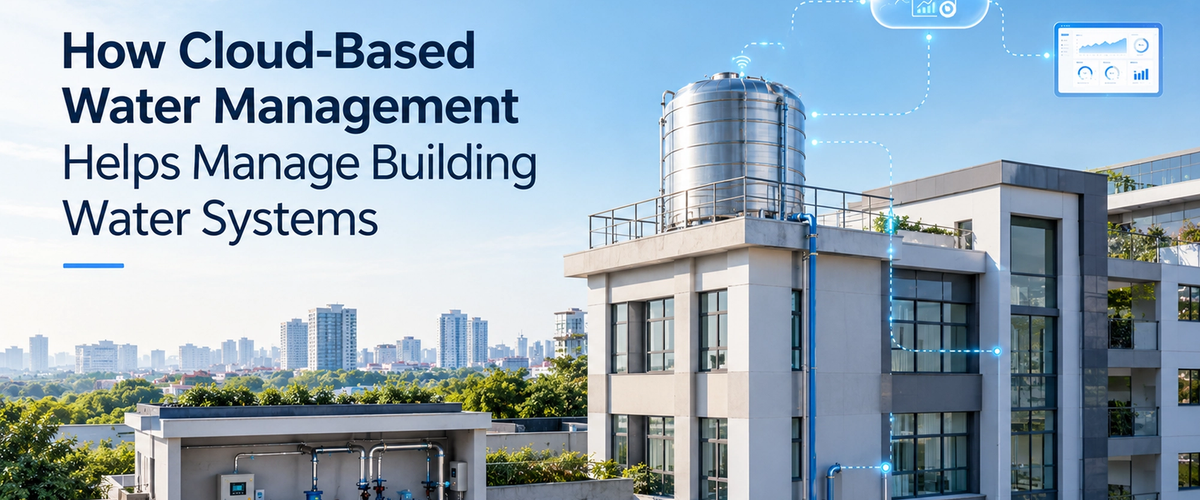
Cloud Based Water Management System
Managing water across a building is more complicated than simply checking whether a tank is full.
Apartment buildings, commercial properties, industrial facilities, campuses and other large sites may have multiple tanks, pumps, pipelines and water sources operating at the same time. When these systems are monitored manually, important information can be missed.
A cloud-based water management system brings this information together in one platform.
Instead of relying on manual tank checks and disconnected equipment, building teams can monitor water levels, consumption, pump activity and other operating conditions from a central dashboard.
This makes water management more visible, measurable and easier to control.
Why Building Water Systems Are Difficult to Manage
A building water system can involve several interconnected components.
Water may move from a borewell or municipal supply into underground tanks, overhead tanks and different parts of the building. Pumps transfer water between levels, while valves and pipelines control distribution.
When this information is managed manually, teams may have to depend on:
- Physical tank inspections
- Manual meter readings
- Pump operator updates
- Separate control panels
- Spreadsheets and maintenance records
- Phone calls when problems occur
This approach can work for a small installation, but it becomes difficult as the number of tanks and buildings increases.
A problem may also remain unnoticed until it becomes serious.
For example, an unexpectedly empty tank could affect water availability. A pump running longer than expected could indicate an operational issue. Continuous water flow during an unusual period could indicate leakage or wastage.
Cloud-based monitoring helps make these conditions visible earlier.
What Is Cloud-Based Water Management?
Cloud-based water management uses connected water level sensors, controllers to collect water-system data and make it available through an online platform.
Instead of keeping information only at the equipment level, the data is transferred to the cloud.
Building teams can then access the information through a dashboard or connected application.
Depending on the system, this can include:
- Water tank levels
- Water consumption
- Flow rates
- Water pressure
- Pump status
- Valve status
- Water quality parameters
- Historical operating data
- Alerts and notifications
The result is a centralized view of the building's water infrastructure.
This is particularly useful when several tanks, pumps or buildings need to be managed together.
How Cloud-Based Water Management Works
A typical cloud-based water management system has four main layers.
Sensors Collect Water Data
Sensors installed in the water infrastructure measure specific parameters.
For example, a radar level sensor can measure the water level inside an overhead or underground tank.
Other sensors can measure flow, pressure or water quality.
The choice of sensor depends on the application and the parameter that needs to be monitored.
Connected Devices Send the Data
The collected information is transmitted through an appropriate communication technology.
Depending on the installation, this may include technologies such as Wi-Fi, cellular connectivity or LoRaWAN.
The objective is to reliably move field data from the building to the cloud platform.
The Cloud Platform Organizes the Information
The cloud platform receives the data and converts it into useful information.
Instead of checking individual devices, operators can view the status of connected water assets through a centralized dashboard.
This makes it easier to understand what is happening across the water system.
Alerts Help Teams Respond
A cloud-based system can also generate alerts when predefined conditions occur.
For example, teams may receive an alert when:
- A tank level becomes critically low
- A tank reaches its upper limit
- Water flow continues unexpectedly
- Pressure falls outside the expected range
- A pump operates abnormally
- A monitored parameter crosses a defined threshold
This changes water management from periodic inspection to continuous monitoring.
What Can Building Teams Monitor From One Platform?
One of the biggest advantages of cloud-based water management is centralization.
Instead of monitoring every tank or equipment panel separately, teams can view multiple water assets from a single platform.
Tank Levels
Real-time tank-level information helps operators understand how much water is available.
This is useful for both underground and overhead tanks.
Historical level data can also show how quickly a tank fills and empties during different periods.
Pump Operation
Pump activity can be monitored alongside tank levels and other operating conditions.
This helps teams identify unnecessary operation, abnormal running patterns and potential problems.
For automated systems, monitoring can also work alongside pump-control logic.
For example:
Tank level LOW + pressure HIGH → Pump ON
Tank level HIGH OR pressure LOW → Pump OFF
This type of logic can help automate water transfer while maintaining visibility of system operation.
Water Consumption
Water consumption monitoring provides insight into how much water a building is actually using.
Instead of looking only at total usage, historical data can help teams compare consumption across different periods.
This can help identify unusual patterns and opportunities to reduce wastage.
Pressure
Water pressure is an important part of building water distribution.
Monitoring pressure can help teams identify changes in system conditions and understand how pressure behaves alongside tank levels and pump operation.
Water Quality
Where appropriate sensors are installed, water quality parameters can also be monitored through the same connected infrastructure.
This can provide a more complete picture of water-system conditions.
How Cloud-Based Water Monitoring Improves Water Management
Cloud-based water management is not simply about putting sensor data online.
Its real value comes from turning continuous data into information that helps people make better operational decisions.
Reduces Dependence on Manual Checks
Manual inspection takes time and may not provide continuous visibility.
A connected system can continuously collect water-system information without requiring an operator to physically visit every tank.
This is especially useful for buildings with multiple tanks or difficult-to-access infrastructure.
Helps Detect Problems Earlier
A water problem is easier to manage when it is detected early.
An unexpected drop in tank level, unusual flow or abnormal pump activity can trigger an alert before the issue becomes a major operational problem.
Early visibility can reduce unnecessary water loss and equipment downtime.
Improves Pump Management
Pumps are critical to many building water systems.
Running pumps unnecessarily can increase energy consumption and equipment wear.
Cloud-based monitoring provides historical information about pump operation and allows teams to understand how pumps are being used.
When combined with automation, monitoring can support more efficient pump operation.
Makes Historical Data Useful
Real-time data tells you what is happening now.
Historical data tells you what has been happening over time.
This distinction is important.
By reviewing historical tank levels, consumption, flow and pump activity, facility teams can identify recurring patterns.
For example, they may discover that:
- Water demand is consistently higher during certain hours
- A tank is being refilled more frequently than expected
- Pump operation has increased over time
- Consumption has changed significantly from previous periods
- A particular building has unusually high water usage
These insights can support better planning and maintenance.
Helps Reduce Water Wastage
Water wastage is often difficult to identify when consumption and system conditions are not continuously monitored.
Cloud-based water management provides greater visibility into water movement and usage.
When unusual patterns appear, teams can investigate possible causes such as leakage, overflow, inefficient pumping or unexpected consumption.
The goal is not simply to collect more data.
It is to use that data to reduce avoidable water loss.
Managing Multiple Buildings From One Platform
The benefits become even more significant when an organization manages multiple buildings.
A property group, campus, industrial site or facility management company may have water infrastructure spread across different locations.
Checking each location independently can make monitoring difficult.
A centralized cloud platform can provide visibility across multiple sites.
Teams can compare:
- Tank levels
- Water consumption
- Pump activity
- Flow
- Pressure
- Alerts
- Historical trends
This creates a common operating view for the organization's water infrastructure.
It also makes it easier for facility teams to prioritize issues instead of treating every location equally.
Why Real-Time Monitoring and Historical Data Work Better Together
Real-time monitoring and historical analysis serve different purposes.
Real-time information helps answer:
What is happening right now?
Historical data helps answer:
Why is this happening, and has it happened before?
Both are important.
A tank that is currently low may not be unusual if demand is high at that time of day.
But if the tank is consistently reaching low levels much earlier than expected, historical data may reveal a changing consumption pattern or an operational issue.
This is why a useful water management platform should provide both live information and historical trends.
How My Tank Supports Cloud-Based Water Management
My Tank brings connected water monitoring and management into a centralized cloud platform which is Web and Mobile App .
Depending on the application, My Tank can connect water-level sensors, flow monitoring, pressure monitoring, water-quality monitoring, pump controllers and other connected devices.
This allows building and facility teams to monitor important water-system conditions from a centralized platform.
My Tank can support applications involving:
- Overhead water tanks
- Underground and sump tanks
- Borewells
- Multiple tanks
- Apartment buildings
- Commercial buildings
- Industrial facilities
- Multi-building sites
The objective is simple: give teams better visibility into their water infrastructure so they can monitor, analyze and manage it more effectively.
Conclusion
Building water systems are becoming more complex, but managing them does not have to become more difficult.
Cloud-based water management connects sensors, monitoring, alerts, historical data and automation into a more centralized approach.
For facility teams, this means better visibility into water levels, consumption, pumps and other critical operating conditions.
More importantly, it creates the foundation for moving from reactive water management to proactive decision-making.
When water-system data is available in the right place at the right time, buildings can be managed with greater visibility, control and efficiency.
Frequently Asked Questions
What is cloud-based water management?
Cloud-based water management is a system that collects water-related data from connected sensors and devices and makes it available through an online platform. It can be used to monitor tank levels, flow, pressure, consumption, pumps and other water-system parameters.
What can a building water management system monitor?
Depending on the equipment installed, a building water management system can monitor tank levels, water flow, pressure, consumption, pump operation, valve status and selected water-quality parameters.
Can cloud-based water management monitor multiple tanks?
Yes. A cloud platform can bring data from multiple tanks into one dashboard. This is useful for apartment buildings, commercial properties, industrial facilities and sites with multiple water-storage points.
Why is historical water data important?
Historical data helps teams identify patterns that may not be visible from real-time readings alone. It can show changes in consumption, tank refill frequency, pump operation and other water-system behavior.
What is the difference between water monitoring and water management?
Water monitoring focuses on collecting and viewing information. Water management goes further by using that information to analyze system performance, detect problems, optimize operations and automate appropriate processes.