How to Monitor Water Tanks Remotely: Complete Guide to Remote Water Monitoring
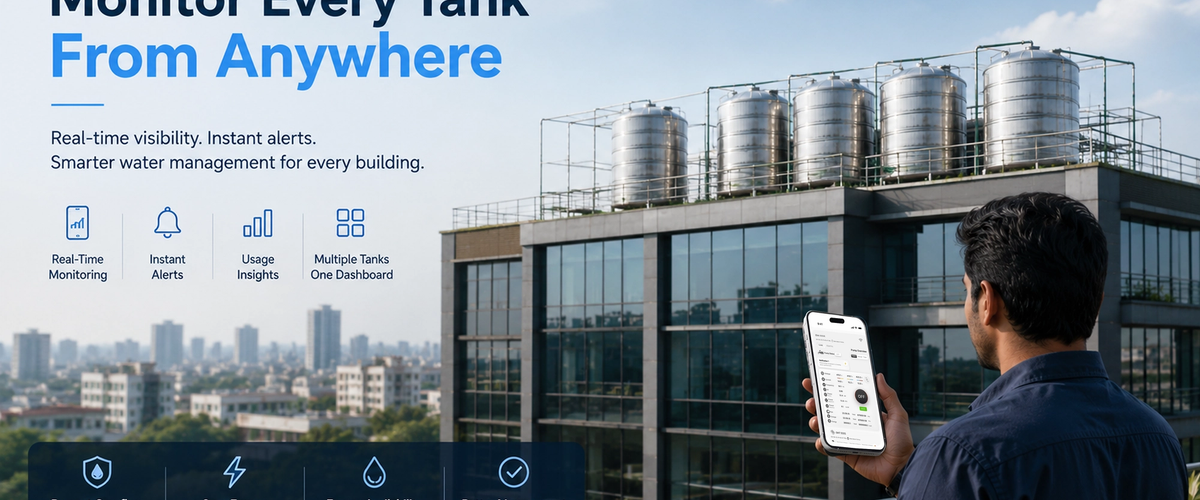
Modern commercial building rooftop with multiple stainless-steel water tanks, while a facility manager remotely monitors tank levels on a smartphone
Monitoring water tanks manually can become difficult when tanks are located on rooftops, underground, across multiple buildings, or in large facilities. Regular physical inspections also make it difficult to know the exact tank level between inspection intervals.
A remote water monitoring system uses connected sensors and wireless communication to continuously collect water-level information and make it available through a centralized cloud platform. Users can then monitor tank levels, receive alerts, view historical data, and, when integrated with a suitable controller, automate pump operation without physically visiting the tank.
A typical remote water tank monitoring system connects a wireless level sensor → connectivity network → cloud platform → mobile or web dashboard.
This approach is useful for apartments, commercial buildings, industries, institutions, campuses, and other facilities managing one or multiple water tanks.
What Is Remote Water Tank Monitoring?
Remote water tank monitoring is the process of measuring tank levels using connected sensors and making the information available from a different location through a communication network and monitoring platform.
Instead of manually climbing to a rooftop tank, opening an inspection point, or sending someone to check the water level, the sensor continuously collects level data and transmits it to a centralized platform.
A remote water monitoring system can provide:
- Current tank level
- Tank filling percentage
- Low- and high-level status
- Historical level data
- Pump status
- Alerts and notifications
- Multiple-tank monitoring
- Water consumption information when flow monitoring is integrated
This allows facility teams to monitor water infrastructure without depending entirely on physical inspections.
How Does Remote Water Tank Level Monitoring Work?
A typical IoT water tank level monitoring system consists of four main stages.
The sensor measures the water level
A radar level sensor is installed above or inside the tank to measure the distance between the sensor and the water surface.
Modern systems can use technologies like radar-based level sensing to provide continuous level measurements.
For applications where low maintenance and contactless measurement are important, radar-based level monitoring can be particularly useful.
The level data is transmitted
The sensor or connected device sends the measured level data through a suitable wireless communication network.
Depending on the application and installation environment, connectivity may include cellular networks, NB-IoT, LoRaWAN, 4G , Wi-Fi or other wireless technologies.
This eliminates the need to physically visit the tank every time you want to check its level.
Data reaches the cloud
The tank-level information is transmitted to a cloud platform where it can be stored, processed and displayed.
This makes it possible to monitor tanks located in different buildings or locations from a centralized interface.
You check the level on your mobile phone
The latest tank status can then be viewed through a mobile application or web dashboard.
Instead of asking:
“Has the tank filled?”
you can simply check the current level remotely.
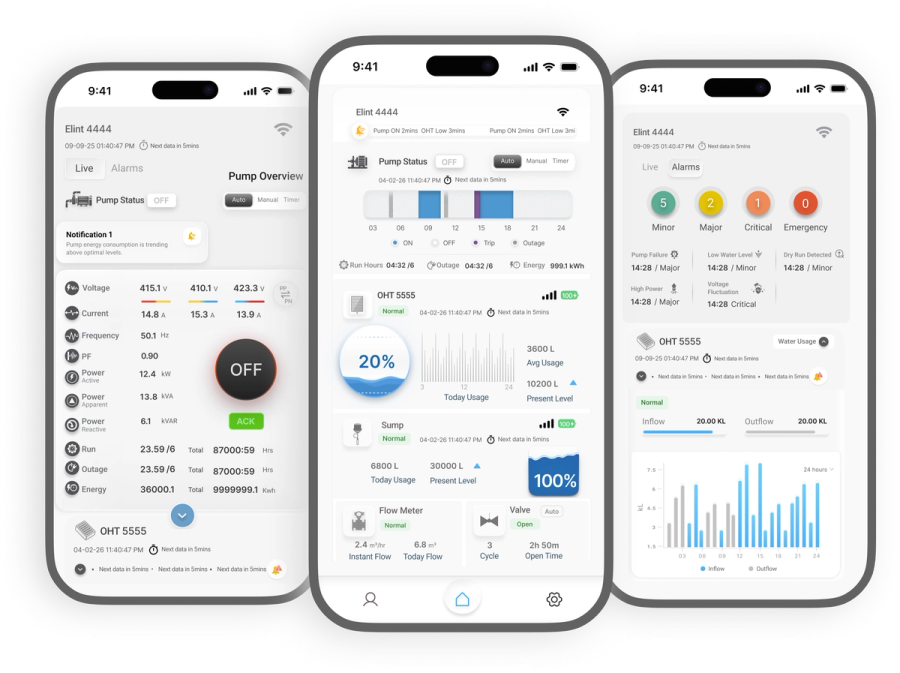
Wireless Sensors for Remote Water Monitoring
Wireless level sensors are an important part of remote water monitoring because they reduce the need for long communication cables between the tank and monitoring equipment.
A suitable wireless level sensor can continuously measure the water level and transmit the data to a gateway or connected communication device.
For water tank applications, radar level sensors can provide non-contact level measurement without requiring the sensor to come into contact with the water.
Wireless monitoring can be particularly useful for:
- Rooftop OHTs
- Underground sumps
- Reservoirs
- Multiple tanks within a building
- Industrial storage tanks
- Remote water assets
- Locations where extensive cabling is difficult
The appropriate sensor and communication technology should be selected according to tank structure, measurement range, installation environment, communication coverage, and monitoring requirements.
How to Monitor Multiple Water Tanks Remotely
Managing one tank manually may be possible, but monitoring multiple tanks across a building or facility becomes significantly more difficult.
A centralized remote water monitoring system can bring multiple connected tanks into a single dashboard. Facility teams can compare tank levels, identify low-level conditions, monitor pump status, review historical data and receive alerts without visiting each location individually.
This approach is particularly useful for:
- Apartment complexes
- Commercial buildings
- Hotels
- Hospitals
- Educational campuses
- Industrial facilities
- Multi-site operations
What Can You See on Your Mobile Phone?
A smart water tank monitoring system can provide much more information than a simple full or empty indication.
Depending on the system configuration, you can monitor:
- Current water level
- Tank filling percentage
- Low-level and high-level status
- Pump status
- Water consumption trends
- Historical tank-level data
- Alerts and notifications
- Multiple tanks from one dashboard
For facilities managing several tanks, centralized monitoring can be particularly valuable because operators don't need to inspect every tank individually.
Can I Receive Alerts When the Tank Level Is Low?
Yes.
One of the biggest advantages of remote water tank monitoring is automatic notification.
For example, you can configure alerts for:
- Low water level
- High water level
- Tank overflow risk
- Pump operation
- Abnormal tank conditions
Instead of discovering an empty tank after the water has already run out, the responsible person can receive an alert and take action earlier.
This can be especially useful in apartments, commercial buildings and facilities where uninterrupted water availability is important.
Can Remote Monitoring Prevent Water Tank Overflow?
Remote monitoring can help reduce overflow, but the real advantage comes when monitoring is combined with automatic pump control.
Consider a conventional setup.
A pump is switched on manually. The tank starts filling. Someone needs to remember to switch the pump off when the tank is full.
If nobody checks the tank, water can overflow.
With a smart water tank automation system, the tank level can be continuously monitored and the pump can be controlled according to configured conditions.
For example:
Tank Level LOW → Pump ON
Tank Level HIGH → Pump OFF
This reduces dependence on manual monitoring and can help prevent unnecessary water wastage.
How MyTank Enables Remote Water Tank Monitoring
My Tank is an IoT-based water management solution designed to make tank monitoring and automation more practical for modern buildings and facilities.
With My Tank, water tank levels can be monitored remotely through a connected dashboard, allowing users to see tank status without physically visiting the tank.
The system combines wireless tank-level monitoring, cloud-based data access, mobile/web dashboards and intelligent notifications.
For suitable applications, tank monitoring can also be integrated with pump automation so that water filling can be managed based on configured tank-level conditions.
One of the key advantages is the wireless approach. MyTank is designed to minimize cabling and simplify deployment, making it suitable for locations where installing extensive wiring is difficult.
Frequently Asked Questions
How can I monitor my water tank remotely?
A remote water monitoring system uses a connected level sensor to measure the tank level and transmit the data to a cloud platform. The current level can then be viewed through a mobile app or web dashboard.
What is a remote water monitoring system?
A remote water monitoring system allows users to monitor water levels and other connected water assets from a different location using sensors, wireless connectivity and a centralized monitoring platform.
Can I monitor multiple water tanks from one mobile phone?
Yes. A centralized monitoring platform can display data from multiple connected tanks on one dashboard, depending on the system configuration.
Does remote water tank monitoring require Wi-Fi?
No. Depending on the installation, remote monitoring can use technologies such as LoRaWAN, 4G, NB-IoT or Wi-Fi.
Can a remote monitoring system control a water pump?
Monitoring alone provides visibility. When integrated with a compatible pump controller, the system can also automate pump operation according to configured conditions.