Smart Water Tank Monitoring for Commercial Buildings in Bengaluru
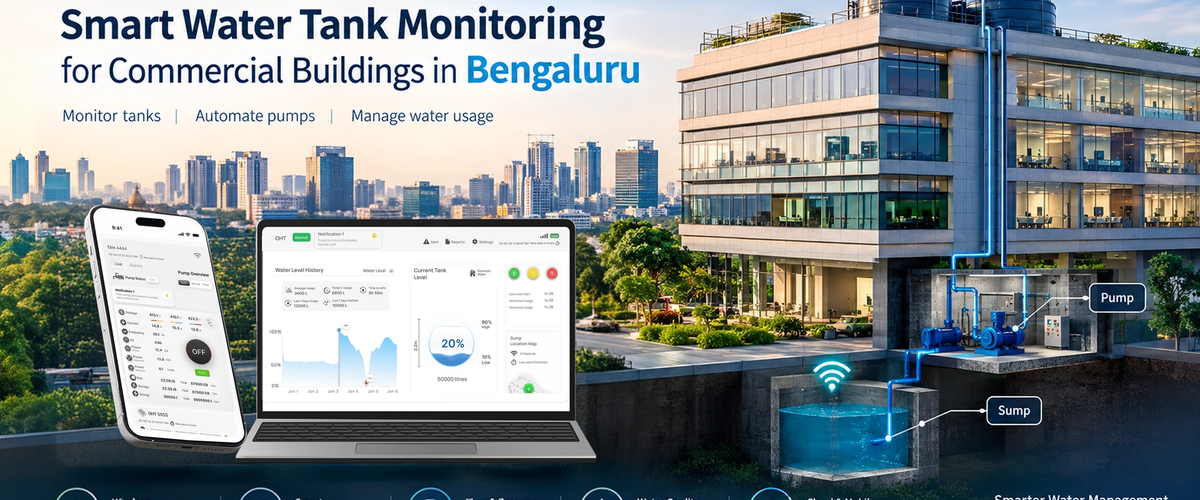
Smart Water Tank Monitoring in Bangalore
Commercial buildings in Bengaluru depend on reliable water infrastructure every day. Office buildings, IT campuses, hotels, hospitals, retail properties and institutional facilities may manage multiple water sources, underground sumps, overhead tanks, pumps and distribution points.
Yet water management in many facilities still depends on manual tank inspections and operators switching pumps ON and OFF.
As the number of tanks and buildings increases, this approach becomes difficult to manage. Facility teams need to know how much water is available, whether pumps are operating correctly, when tanks need attention and where abnormal consumption may be occurring.
This is where smart water tank monitoring for commercial buildings in Bengaluru can make water infrastructure more visible, connected and easier to operate.
A modern IoT-based system combines wireless water level sensors, pump controllers, flow monitoring, alerts and a centralized dashboard so facility teams can monitor water infrastructure without constantly visiting every tank.
Why Commercial Buildings in Bengaluru Need Smarter Water Management
Commercial properties often have a more complex water network than a single residential building.
Depending on the property, water may come from sources such as:
- Municipal water supply
- Borewells
- Tankers
- Recycled or treated water
- Rainwater harvesting systems
Water is then stored in underground sumps or other storage tanks before being pumped to overhead tanks and distributed throughout the building.
This creates several points that need to be monitored.
A facility team may need to know:
- How much water is available in the sump
- Whether the OHT has sufficient water
- Whether a pump is running
- Whether a pump has been running longer than expected
- Whether a tank is approaching overflow
- Whether water consumption is changing unexpectedly
- Whether water is available across multiple buildings
Manual checks provide only periodic information.
Smart water monitoring provides continuous visibility.
What Is Smart Water Tank Monitoring?
A smart water tank monitoring system uses sensors, wireless communication and software to continuously collect information from water storage and distribution infrastructure.
Instead of depending on someone to physically inspect a tank, a connected system can transmit water-level data to a centralized platform.
For a commercial building, this can include:
Tank level → Pump status → Flow → Pressure → Alerts → Dashboard
The facility team can view the status of connected assets through a web or mobile interface and respond when action is required.
With a complete water management platform, monitoring can also extend beyond tank levels to pump automation, water flow, valves and water quality.
From Sump to OHT: How the System Works
A typical commercial building water system can be represented as:
Water Source → Sump → Pump → OHT → Building Distribution
Each stage has an operational role.
Monitor the Water Source
Commercial buildings may receive water from different sources depending on their infrastructure.
Monitoring source availability can help facility teams understand whether sufficient water is entering the storage system.
For borewell-based systems, for example, monitoring can provide visibility into available water and help coordinate pumping operations.
Monitor the Underground Sump
The sump is an important part of the water system because it acts as the storage point before water is transferred to the overhead tank.
A wireless level sensor can continuously measure the sump level.
This helps answer a simple but important question:
Is there enough water available for the transfer pump to operate?
Monitoring the sump can also help reduce unnecessary manual inspections and provide alerts when the water level reaches configured limits.
Automate the Pump
The pump transfers water from the sump to the OHT.
Instead of relying entirely on manual operation, automatic water pump controller can use tank and pressure conditions to automate operation.
For example:
Tank level LOW AND pressure HIGH → Pump ON
Tank level HIGH OR pressure LOW → Pump OFF
This allows pump operation to respond to actual system conditions rather than depending solely on manual intervention.
Monitor the OHT
The overhead tank supplies water to the building distribution network.
A wireless radar level sensor can continuously measure the OHT level and transmit the information to the monitoring platform.
Facility teams can therefore see whether the OHT is:
- Filling
- At normal operating level
- Running low
- Approaching the configured high level
This provides visibility without requiring staff to physically access rooftops or inspect tanks repeatedly.
Why Wireless Monitoring Matters in Commercial Buildings
One of the challenges in existing commercial buildings is installation.
Running cables between rooftops, pump rooms, underground sumps and control panels can involve additional installation work.
Wireless water tank monitoring can simplify this architecture.
Depending on the deployment, wireless connectivity such as LoRaWAN, 4G, Wi-Fi, Cat-M1 or NB-IoT can transmit sensor information to the monitoring platform.
For facilities with multiple tanks, wireless monitoring can also make future expansion easier.
Instead of treating every tank as an isolated installation, the facility can build a connected water-management network.
Monitor Multiple Tanks from One Dashboard
A commercial building may have several tanks serving different areas or functions.
A larger campus may have:
- Multiple underground sumps
- Multiple OHTs
- Separate buildings
- Fire-water storage
- Utility tanks
- Recycled-water storage
Checking each location manually can consume significant operational time.
A centralized water tank monitoring system in Bangalore can bring these data points together.
Facility teams can monitor:
- Tank levels
- Pump status
- Water flow
- Pressure
- Alerts
- Historical data
- Multiple locations
This changes water management from isolated manual checks into centralized infrastructure monitoring.
Alerts for Faster Response
A smart water monitoring system becomes more useful when it does more than display data.
Configured alerts can notify facility teams when important conditions occur.
Examples include:
- Low tank level
- High tank level
- Overflow risk
- Pump status changes
- Dry-run conditions
- Abnormal water usage
- Communication or device issues
Instead of discovering a problem during the next physical inspection, the facility team can receive information closer to when the event occurs.
This is particularly useful for commercial properties where water availability directly affects daily operations.
Smart Water Management in Bengaluru: Beyond Tank Level
The goal of smart water management in Bengaluru is not simply to replace a manual tank indicator with a digital one.
The larger objective is to connect the different parts of the water infrastructure.
A complete system can combine:
Wireless Radar Level Sensors -> Pump Controllers ->Flow & Pressure Monitoring ->Water Quality Monitoring ->Cloud Dashboard ->Alerts & Automation
This creates a connected operational layer across the building's water infrastructure.
How My Tank Supports Commercial Building Water Management
My Tank is designed as a connected water-management platform rather than a standalone tank-level indicator.
A commercial building can combine multiple components based on its requirements.
Wireless Radar Level Sensors
Wireless radar sensors continuously measure water levels without requiring physical contact with the water.
They can be deployed for applications such as:
- OHT monitoring
- Sump monitoring
- Water storage tanks
- Industrial water tanks
- Other connected storage points
Smart Pump Controllers
Pump controllers can automate pump operation based on configured water-level and pressure conditions.
This helps reduce dependence on manual pump switching.
Flow Monitoring
Flow meters can provide visibility into water movement and consumption, helping facility teams understand how water is being used.
Water Quality Monitoring
Where required, water quality sensors can monitor parameters such as pH, TDS, EC, chlorine, turbidity and temperature.
This allows water-quality information to become part of the same monitoring ecosystem.
Cloud and Mobile Monitoring
Connected devices transmit data to the MyTank platform, allowing authorized users to monitor their water infrastructure through dashboards and mobile interfaces.
For facilities managing multiple tanks or locations, centralized visibility can simplify daily operations.
Bengaluru Is Part of a Larger Indian Water-Management Challenge
The requirement for connected water infrastructure is not limited to Bengaluru.
Different cities have different water-management conditions, but commercial and institutional facilities across India face similar operational requirements: monitor storage, manage pumps, understand consumption and respond quickly to abnormal conditions.
This is why IoT water tank monitoring systems in India are becoming relevant across residential, commercial, industrial, healthcare and institutional applications.
Bengaluru is one use case within this larger shift toward connected water infrastructure.
Similar approaches can also be adapted for facilities looking at smart water management in Hyderabad, Chennai and other growing cities, with the exact system architecture depending on local water sources, storage arrangements and operational requirements.
Conclusion
Commercial buildings in Bengaluru manage increasingly complex water infrastructure, from incoming water sources and underground sumps to pumps, OHTs and building distribution networks.
Manual inspection can provide only limited visibility.
Smart water tank monitoring for commercial buildings in Bengaluru provides a connected approach by combining wireless level sensing, pump automation, flow monitoring, alerts and centralized dashboards.
With a system such as My Tank, facility teams can move toward continuous monitoring and automated water operations while creating a foundation for more data-driven water management.
For commercial buildings, the objective is simple:
Know your water. Control your pumps. Reduce avoidable waste. Manage the entire system from one connected platform.
Frequently Asked Questions
What is smart water tank monitoring for commercial buildings?
Smart water tank monitoring uses connected level sensors, wireless communication and software to continuously monitor tanks such as underground sumps and OHTs. The data can be viewed remotely and used for alerts and pump automation.
How can commercial buildings in Bengaluru monitor water tanks remotely?
A wireless radar level sensor can measure the water level and transmit the data through suitable connectivity to a cloud monitoring platform. Facility teams can then view tank levels through a web or mobile dashboard.
Can a water tank monitoring system in Bangalore monitor multiple tanks?
Yes. A connected system can monitor multiple OHTs, sumps and other storage points from a centralized dashboard, depending on the system architecture and deployment requirements.
Is wireless water tank monitoring suitable for existing buildings?
Wireless monitoring can be useful for existing buildings because it can reduce the need for extensive cabling between tanks and monitoring equipment. The appropriate connectivity and installation architecture depend on the property.