Wired vs Wireless Water Tank Level Sensors: Which Is Better for Your Application?
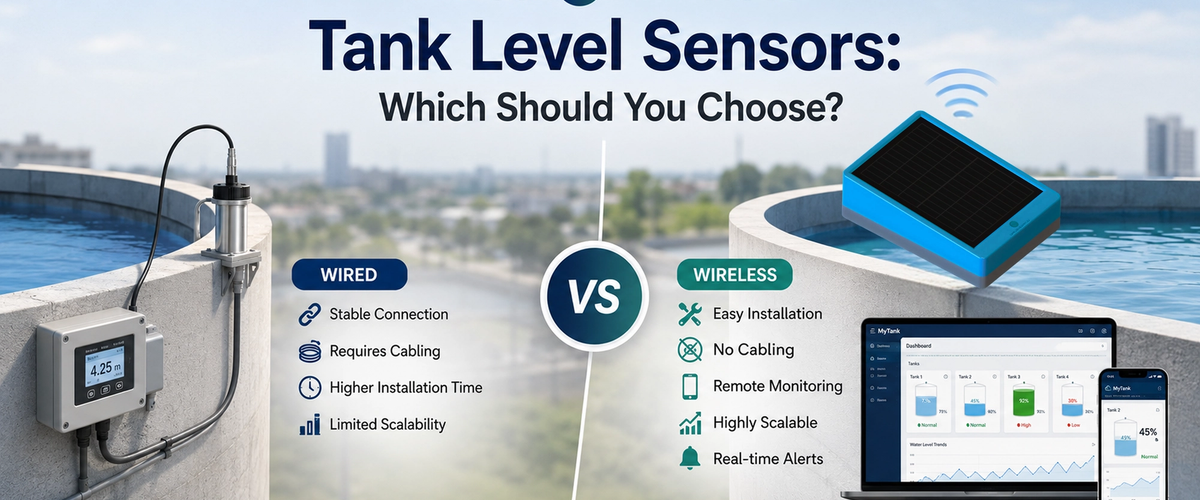
Compare wired and wireless water tank level sensors to choose the right monitoring solution.
Choosing between a wired and wireless water tank level sensor depends on more than sensor accuracy. Installation conditions, cable requirements, remote monitoring, pump automation, maintenance, scalability and the number of tanks all influence which solution is the better fit.
For a single tank with existing cabling and a local control system, a wired sensor can be a practical choice. For commercial buildings, industrial facilities or sites with multiple tanks where remote monitoring and easier expansion are important, a wireless water tank monitoring system can offer greater flexibility.
In this guide, we'll compare wired and wireless water tank level sensors across the factors that matter most — installation, communication, maintenance, accuracy, remote monitoring, pump control, scalability and long-term operational requirements.
Quick answer: Neither technology is universally better. The right choice depends on the application. Wired systems are well suited to fixed installations with existing infrastructure, while wireless systems are particularly useful when tanks are distributed, cabling is difficult, or remote monitoring and scalability are priorities.
Why Choosing the Right Water Tank Level Sensor Matters
Water tanks are essential for storing and distributing water across residential, commercial, and industrial facilities. However, relying on manual inspections or basic float switches often leads to operational challenges such as:
- Water overflows
- Dry-running pumps
- Unexpected water shortages
- Delayed maintenance
- Increased labor costs
- Water wastage
A modern water tank level sensor continuously monitors water levels and provides real-time information, enabling operators to respond quickly before problems occur. Combined with cloud connectivity and automation, these sensors become the foundation of an efficient water management system.
What Is a Wired Water Tank Level Sensor?
A wired water level sensor communicates with a controller or monitoring system through physical cables.
The sensor measures the water level and sends data directly to a local display, PLC, or SCADA system using wired connections.
Wired systems have been widely used for many years because they provide stable communication in installations where cable infrastructure already exists.
Common Applications
- Residential buildings
- Small industrial tanks
- Local automation systems
- Single tank installations
Advantages
- Stable communication
- Suitable for existing wired infrastructure
- Reliable for local monitoring
Limitations
- Requires extensive cabling
- Longer installation time
- Difficult to expand
- Cable maintenance increases over time
- Limited remote monitoring capabilities
For facilities managing multiple tanks across different locations, installing and maintaining cables can become both expensive and time-consuming.
What Is a Wireless Water Tank Level Sensor?
A wireless water tank level sensor measures the water level and transmits the data without physical cables.
Instead of wired communication, it uses technologies such as LoRaWAN, NB-IoT, Cellular (4G), or Wi-Fi to send data securely to a cloud platform or monitoring dashboard.
Operators can access tank information from anywhere using a computer or mobile device.
Wireless monitoring is increasingly used in apartments, industries, municipalities, campuses, commercial buildings, and agricultural applications because it simplifies deployment while providing real-time visibility.

Wired vs Wireless Tank Level Sensors: Understanding the Difference
Installation
A wired water tank level sensor requires cables between the sensor, controller, and monitoring system. Depending on the facility layout, installation may involve trenching, conduit work, and additional electrical infrastructure.
Wireless sensors eliminate the need for long cable runs. Installation is faster, cleaner, and causes minimal disruption, making them an excellent choice for both new and existing facilities.
Maintenance
Maintaining wired systems often involves inspecting cables, connectors, and electrical components that may deteriorate due to weather, moisture, or accidental damage.
Wireless systems have fewer physical components exposed to these issues. Maintenance is generally limited to periodic device health checks, reducing operational effort and downtime.
Remote Monitoring
Traditional wired systems typically provide local monitoring through control panels or PLCs.
Wireless water level sensors allow users to monitor water levels remotely using cloud dashboards and mobile applications. Facility managers can receive instant notifications for low water levels, overflows, pump failures, or abnormal conditions without visiting the site.
Scalability
Expanding a wired monitoring system usually requires new cabling and additional installation work.
Wireless systems are much easier to scale. Additional sensors can be deployed across multiple tanks or sites without significant infrastructure changes, making them ideal for growing organizations.
Cost Over Time
A wired solution may appear economical for a small installation where wiring already exists.
However, as the number of tanks increases, installation, maintenance, and expansion costs also rise.
Wireless monitoring reduces these long-term expenses by minimizing cabling, simplifying maintenance, and enabling centralized management across multiple locations.
Wired vs Wireless: Which One Is More Accurate?
Wireless does not automatically mean less accurate, and wired does not automatically mean more accurate.
Measurement accuracy depends primarily on the sensing technology, sensor design, installation conditions and application — not simply on the communication method.
For example, a radar level sensor measures the distance to the liquid surface using radar technology. Whether the resulting measurement is transmitted through a wired interface or a wireless communication network is a separate consideration.
When selecting a sensor, evaluate:
- Measurement range
- Accuracy and repeatability
- Tank geometry
- Installation position
- Liquid characteristics
- Environmental conditions
- Communication method
- Power availability
- Required update frequency
This distinction is important when comparing water tank level monitoring systems because sensing performance and communication architecture solve two different problems.
Which Solution Is Better for Smart Water Management?
Modern smart water management goes beyond simply measuring water levels.
Organizations now need complete visibility into their water infrastructure, including:
- Live tank status
- Remote access
- Historical reports
- Automated alerts
- Pump automation
- Multi-site monitoring
- Preventive maintenance
Wireless monitoring systems are designed to support these capabilities, helping organizations improve efficiency while reducing operational costs.
For facilities with multiple tanks spread across different buildings or locations, wireless technology offers greater flexibility and long-term value.
When Should You Choose a Wired Water Level Sensor?
A wired solution is a practical option if:
- You have a single tank
- Existing cable infrastructure is available
- Remote monitoring is not required
- Future expansion is unlikely
- The monitoring system remains within a limited area
When Should You Choose a Wireless Water Level Sensor?
A wireless solution is the better choice if you want to:
- Monitor multiple tanks
- Reduce installation time
- Eliminate extensive cabling
- Access data remotely
- Receive instant alerts
- Scale your monitoring system easily
- Improve operational efficiency
For most commercial, industrial, and municipal applications, wireless monitoring provides greater flexibility while supporting modern smart water management initiatives.
Wired vs Wireless Water Tank Monitoring for Commercial and Industrial Facilities
The choice becomes more important when a facility has multiple tanks, buildings or water systems to manage.
A commercial or industrial facility may need to monitor:
- Underground sumps
- Overhead water tanks
- Process water tanks
- Borewell storage tanks
- Fire-water tanks
- Recycled or treated water tanks
- Multiple buildings or remote locations
With a wired system, each additional monitoring point may require new cable routes, conduits, termination points and installation work.
A smart water tank monitoring for commercial buildings can reduce this infrastructure requirement by transmitting tank-level data wirelessly to a gateway, controller or cloud platform, depending on the system architecture.
This makes wireless monitoring particularly useful when tanks are separated by floors, buildings or large outdoor areas.
When wired monitoring makes more sense
Choose a wired water level sensor when:
- Cable infrastructure is already available
- The sensor and controller are located close together
- Continuous wired communication is required
- The installation is fixed and unlikely to expand
- The facility already uses PLC, SCADA or BMS infrastructure
When wireless monitoring makes more sense
Consider wireless monitoring when:
- Tanks are physically separated
- Cable installation is difficult or expensive
- Existing buildings need to be upgraded
- Multiple tanks need to be monitored
- Remote access is required
- The system may need to expand later
- Facility teams want centralized monitoring
The decision should therefore be based on the complete monitoring architecture rather than the sensor alone.
How My Tank Simplifies Smart Water Management
For facilities where installing long cable runs is difficult, MyTank provides a wireless approach to water tank monitoring and automation.
The platform can bring together:
- Wireless radar level sensors
- Smart pump controllers
- Flow monitoring
- Pressure monitoring
- Water quality monitoring
- Cloud and mobile dashboards
- Alerts and remote monitoring
- Multi-tank monitoring
This allows facility teams to move from checking individual tanks manually to managing connected water infrastructure from a centralized platform.
For commercial buildings, apartments, hospitals, industrial facilities, campuses and other multi-tank environments, the combination of wireless level monitoring and pump automation can simplify day-to-day water management.
Final Thoughts
Both wired and wireless water tank level sensors are capable of measuring water levels effectively, but they serve different operational needs.
A wired solution works well for small installations with existing infrastructure and minimal expansion requirements.
However, if your goal is to enable remote monitoring, simplify installation, reduce maintenance, and build a scalable smart water management system, a wireless solution offers clear long-term advantages.
When combined with a high-accuracy radar level sensor, wireless monitoring delivers the reliability, flexibility, and real-time visibility needed for modern water infrastructure.
Investing in the right monitoring technology today helps improve operational efficiency, reduce water wastage, and ensure reliable water availability for years to come.
Ready to Modernize Your Water Tank Monitoring?
Whether you're managing a single water tank or hundreds of storage tanks across multiple locations, MyTank helps you monitor water levels in real time with advanced radar level sensors, instant alerts, and cloud-based dashboards.
Schedule a CallFrequently Asked Questions
What is the difference between a wired and wireless water tank level sensor?
A wired water tank level sensor sends measurement data through physical cables, while a wireless sensor transmits data using technologies such as LoRaWAN, 4G, NB-IoT or Wi-Fi. The best option depends on installation conditions, monitoring requirements and system architecture.
Which is better for commercial water tank monitoring: wired or wireless?
Wireless monitoring can be advantageous for commercial facilities with multiple tanks, difficult cable routes or a requirement for remote monitoring. Wired sensors can be preferable where existing cabling and PLC or SCADA infrastructure are already available.
Can wireless water tank level sensors control pumps?
Yes. A wireless level sensor can provide tank-level data to a compatible pump-control system. The complete system architecture determines how level conditions are used for automatic pump operation.
Why are radar level sensors preferred for water tanks?
Radar level sensors provide accurate, non-contact measurement and are less affected by humidity, condensation, or water quality changes. They require minimal maintenance and are ideal for long-term monitoring.
What is the best water tank level sensor for remote monitoring?
The best sensor depends on the tank, measurement range, liquid, environment, power availability and communication requirements. For remote water monitoring, non-contact radar level sensors combined with suitable wireless connectivity can provide a practical solution.