Smart Water Management System Platform for Municipalities: Complete Guide
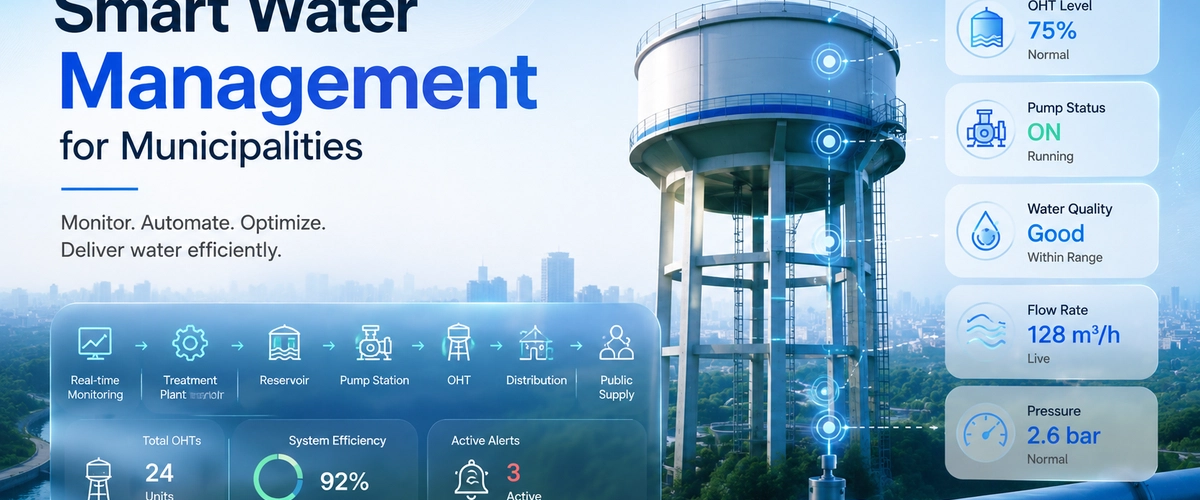
Smart Water Management Solution
Managing water across a municipality is a complex operation. Water may be sourced from groundwater, borewells, rivers, reservoirs and other water sources, treated at a water treatment plant, transferred through pumping stations, stored in OHTs and finally distributed to homes, businesses and public facilities.
When these assets are spread across multiple locations, depending on manual inspections and conventional pump operation can make municipal water management time-consuming and difficult to control.
A Smart Water Management System for municipalities connects critical water infrastructure using wireless IoT sensors, automation, wireless communication and cloud-based monitoring. It provides municipal authorities with real-time visibility of water operations from the source to distribution.
What Is a Smart Water Management System for Municipalities?
A municipal smart water management platform connects different stages of the water supply network into one centralized system.
The overall water journey can be represented as:
Water Source → Treatment Plant → Reservoir → Pump Station → OHT → Distribution Network → Public Supply
At each stage, different parameters need to be monitored. Depending on the application, municipalities can monitor water quality, pump operation, OHT water level, flow, pressure and valve status.
This connected approach helps water authorities move from manual and reactive operations toward real-time municipal water monitoring and automation.
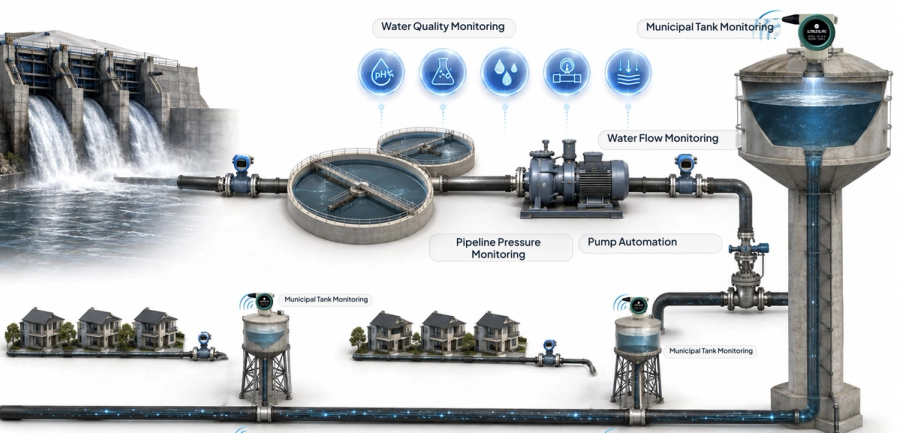
Monitoring Groundwater and Municipal Water Sources
Groundwater and borewells are important water sources for many municipalities.
IoT-based tank monitoring can help municipal authorities understand source availability, pumping activity and water extraction. Flow monitoring can also provide information about the quantity of water being pumped from different sources.
When multiple borewells or water sources are located across different areas, data can be collected remotely and brought into a centralized platform.
This gives municipal teams better visibility into groundwater-based water supply operations and helps them make informed decisions about source utilization and pumping.
Water Quality Monitoring at Treatment Plants
Before water is transferred into the municipal supply network, it may pass through a water treatment plant. Monitoring water quality at this stage is essential for maintaining consistent treatment performance.
An IoT-based water quality monitoring system can monitor parameters such as:
- pH
- Turbidity
- Chlorine
- TDS
- Electrical Conductivity
- Temperature
Real-time monitoring can help identify abnormal conditions and provide alerts when monitored parameters move outside configured limits.
This provides municipal water authorities with continuous visibility into important water quality parameters rather than depending only on periodic manual checks.
Reservoir and Water Transfer Monitoring
After treatment, water is stored in municipal reservoirs before being transferred to pumping stations and OHTs.
At this stage, the focus is on managing the water transfer and pumping process efficiently.
IoT-enabled pump monitoring & automation can provide information such as pump ON/OFF status, operating runtime, and fault conditions. This information helps municipal operators understand how water is being transferred through the network.
The reservoir-to-OHT transfer process can then be coordinated with the water level requirements of downstream OHTs.
Smart Pump Station Monitoring and Automation
Pumping stations are responsible for transferring water from reservoirs and other storage points to OHTs and supply zones.
For municipalities operating multiple pumping stations, manual pump operation can become difficult and resource-intensive.
A wireless automatic pump controller can automate pump operation based on configured conditions such as OHT water level, operating schedules, and other system parameters.
For example:
OHT Low Level → Pump ON
OHT High Level → Pump OFF
Pump status, runtime, and operation history can also be monitored remotely.
This enables municipalities to automate routine pumping operations while maintaining centralized visibility of pump performance.
OHT Water Level Monitoring Using Radar Level Sensors
OHTs are a critical part of municipal water distribution because they store water before it is supplied to different areas.
Maintaining the correct OHT water level is therefore essential.
A solar-powered radar level sensor can continuously measure the water level inside an OHT using non-contact measurement. For OHTs located across different municipal areas, a wireless radar level sensor can transmit real-time level information without requiring extensive communication cabling.
The system can provide information such as:
- Current OHT water level
- Low-level alerts
- High-level alerts
- Filling status
- Overflow risk
- Historical water-level data
OHT level information can also be used by a wireless automatic pump controller to automate water filling.
For example, when the OHT reaches a configured low level, the pump can start automatically. When the OHT reaches the high-level threshold, the pump can stop.
This combination of radar level sensing and automatic pump control can significantly reduce manual intervention in municipal OHT operations.
LoRa, 4G and Wi-Fi Connectivity for Municipal Water Monitoring
Municipal water infrastructure is often distributed across large geographical areas, so communication is an important part of an IoT water management system.
Different connectivity technologies can be used according to the site and infrastructure requirements.
LoRa can be suitable for long-range communication between wireless sensors and gateways across distributed municipal assets.
4G connectivity can provide direct cellular communication for remote OHTs, pumping stations and other locations where cellular coverage is available.
Wi-Fi can be used at sites where reliable local network connectivity is already available.
Using the appropriate communication technology allows municipalities to connect geographically distributed water assets to a centralized monitoring platform.
Smart Valve Management for Water Distribution
After water reaches OHTs, it is distributed through pipelines to different areas.
Valves play an important role in controlling water movement across distribution zones.
Smart or remotely controlled valves can help municipalities manage water distribution according to operational requirements.
When remote valve control is combined with OHT level, flow and pressure monitoring, municipal operators can gain better visibility and control over how water moves through different supply zones.
Flow and Pressure Monitoring in Municipal Distribution
Once water enters the distribution network, municipalities need to understand how much water is being supplied and how the network is performing.
A water flow monitoring system can measure the quantity of water moving through important points in the distribution network.
At the same time, water pressure monitoring can provide information about pressure conditions across different distribution zones.
Abnormal flow or pressure patterns may indicate conditions requiring investigation, such as pipeline issues, possible leakage, supply interruptions or unusual water consumption.
Monitoring these parameters across different zones can help municipalities improve water distribution management and water accounting.
Reducing Water Loss and Non-Revenue Water
Non-Revenue Water (NRW) refers to water that enters a distribution system but is not ultimately billed or accounted for as revenue-generating consumption.
Water losses can result from pipeline leakage, overflow, unauthorized consumption, inaccurate measurement and other distribution problems.
IoT-based flow, pressure and OHT level monitoring can help municipalities identify abnormal conditions and improve visibility into where water may be lost.
For example, municipalities can compare the water entering a distribution zone with the water that is accounted for through authorized consumption. Significant differences can highlight areas that require further investigation.
IoT does not directly generate revenue for municipalities. Instead, it can help reduce avoidable water losses, improve water accounting, optimize operations and support better utilization of the available water supply.
Centralized Smart Water Management for Municipalities
The real value of a smart water management platform comes from connecting these individual operations into one system.
My Tank brings these monitoring and automation requirements together through an IoT-based Smart Water Management Platform for Municipalities.
Depending on the application, municipalities can deploy radar level sensors, wireless radar level sensors, wireless automatic pump controllers, LoRa, 4G and Wi-Fi connectivity, along with water quality, flow, pressure and valve monitoring.
Data from connected assets can be viewed through a centralized dashboard with real-time status, alerts, historical trends and operational information.
Conclusion
Municipal water management involves a complete network of interconnected operations - from groundwater and other water sources to treatment plants, reservoirs, pumping stations, OHTs and distribution networks.
An IoT-based Smart Water Management System for municipalities provides the visibility and automation required to manage this network more efficiently.
My Tank - 100% wireless Smart Water Management Platform helps municipalities monitor, automate and manage critical water infrastructure from a centralized platform- supporting more efficient water distribution, better operational control and smarter water management.
The future of municipal water management is not simply about supplying water. It is about knowing where the water is, how it is moving, how the infrastructure is performing and how every stage can be managed more intelligently.
Frequently Asked Questions
What is a smart water management system for municipalities?
A smart water management system uses IoT sensors, automation, wireless connectivity and cloud monitoring to manage municipal water infrastructure, including OHTs, pumps, water quality, flow, pressure and valves.
How can IoT help municipalities manage water supply?
IoT enables municipalities to remotely monitor water levels, pump operations, water quality, flow and pressure across multiple locations through a centralized dashboard.
How does a radar level sensor help in municipal water management?
A radar level sensor continuously measures water levels in municipal OHTs without physical contact. It can help monitor low levels, high levels and overflow conditions.
Can smart water management help reduce Non-Revenue Water (NRW)?
Yes. Monitoring flow, pressure and water levels can help municipalities identify abnormal water-loss patterns and improve water accounting across distribution zones.
Which connectivity technologies can be used for municipal IoT water monitoring?
Depending on the site, municipalities can use LoRa, 4G or Wi-Fi connectivity to transmit data from OHTs, pumping stations and other water infrastructure to a centralized platform.