Water Consumption Monitoring: How to Track Water Flow and Reduce Water Usage
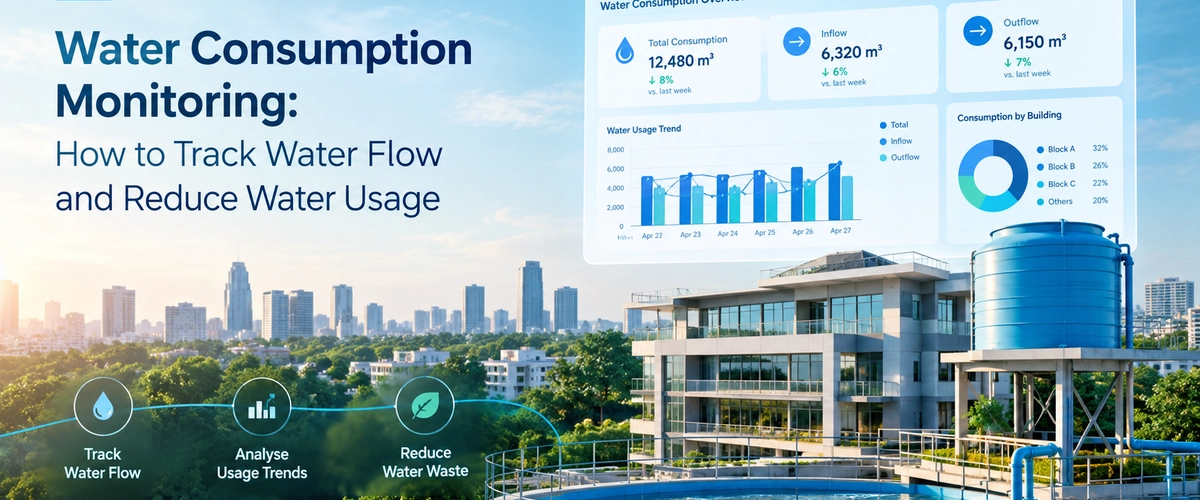
Water Consumption Monitoring
Water is used every day across apartments, commercial buildings, hospitals, hotels and industrial facilities. Yet many organizations still rely on manual meter readings and periodic inspections to understand their water consumption.
This creates a visibility gap. Facility teams may know how much water enters a building, but not how it is distributed, where consumption increases or why storage levels change unexpectedly. Small leaks, overflowing tanks and inefficient pump operations can go unnoticed.
Water consumption monitoring helps organizations understand how water enters, moves through and leaves their systems. By combining water flow monitoring, tank-level sensors and historical data, facility teams can identify unusual usage patterns and make better-informed decisions.
What Is Water Consumption Monitoring?
Water consumption monitoring is the process of measuring and reviewing how much water is used over a specific period. A water flow meter measures the volume of water passing through a pipeline, while connected monitoring systems can collect readings for centralized viewing and analysis.
A water consumption monitoring system can help track:
- Water inflow from the main supply or other sources.
- Water outflow through selected distribution lines.
- Tank levels and changes in stored water.
- Consumption patterns across different periods.
- Unusual flow and potential water losses.
When these measurements are reviewed together, organizations gain a clearer picture of their water usage instead of relying on isolated readings.
How Does Water Flow Monitoring Work?
Water flow monitoring measures the movement of water through selected pipelines using suitable flow meters. Depending on the system design, meters can be installed at the incoming supply, tank filling lines or outgoing distribution points.
The readings can be transmitted to a connected platform, where facility teams can view current measurements and review recorded data.
For example, a commercial building can monitor incoming water supply, the flow used to fill its storage tanks and the water distributed to selected areas. Comparing these measurements helps teams understand how water moves through the system.
For reliable interpretation, meters must be installed at appropriate points, and readings should be compared over matching time periods while accounting for changes in tank storage and other relevant factors.
Inflow vs. Outflow: Why Both Matter
Monitoring only incoming water provides an incomplete picture of consumption. Tracking inflow and outflow at selected points can help explain how water is distributed and where further investigation may be needed.
- Inflow monitoring measures water entering a system, such as water supplied to a building or delivered into a storage tank.
- Outflow monitoring measures water leaving a selected point, such as a tank outlet or a distribution pipeline.
Consider a building that receives water from an external supply and stores it in an underground sump before pumping it to overhead tanks. Monitoring the incoming supply, tank levels and selected outgoing lines helps facility teams understand the movement of water across these stages.
If incoming and outgoing readings show an unexpected difference, it does not automatically prove a leak. Storage changes, unmetered outlets, timing differences and other operational factors may explain the variation. However, the data can help teams identify where to investigate.
This is particularly useful for large buildings and industrial facilities with multiple tanks, pumps and distribution lines.
Common Water Management Problems - and How Monitoring Helps
Unexplained increases in water consumption
A sudden rise in water usage can result from increased demand, leakage, faulty equipment or changes in operating schedules.
Water flow monitoring provides recorded measurements that teams can compare against previous periods. An unusual increase can trigger an inspection before the issue continues unnoticed.
Water leakage and distribution losses
Leaks may continue for hours before they are discovered through a site inspection or a water bill.
Flow readings can help identify unexpected or continuous water movement, including during periods when demand should be low. These patterns are indicators for investigation, rather than automatic confirmation of a leak.
Tank overflow and inefficient pumping
Overhead tanks and underground sumps require coordinated level monitoring and pump operation. Without adequate visibility, pumps may run longer than necessary, or water may overflow when filling is not stopped at the appropriate level.
Combining tank-level sensors with pump controllers helps teams monitor storage conditions and automate pump operation according to configured rules.
Limited visibility across multiple locations
Apartments, hotels, hospitals and industrial campuses may have numerous tanks and water distribution points. Manual readings from each location make it difficult to maintain a consistent overview.
A centralized water monitoring dashboard brings supported devices and measurements into one view, helping facility teams identify issues and prioritize action.
How Historical Water Consumption Trends Improve Decisions
Real-time readings show what is happening now. Historical data helps explain how water usage changes over time.
When water flow readings are recorded consistently, teams can compare daily, weekly or monthly patterns, depending on the platform's reporting capabilities and available data.
Historical water consumption trends can help organizations:
- Compare usage across different periods.
- Identify recurring peaks in water demand.
- Investigate sudden changes in consumption.
- Review whether operational changes improve efficiency.
- Support water budgeting and planning.
- Establish a baseline for identifying unusual usage.
For example, a facility manager may notice that water consumption regularly increases during a particular operating shift. Reviewing flow readings alongside pump activity, tank levels and operating schedules can help determine whether the increase reflects normal demand or an issue that needs attention.
Historical comparisons are most useful when readings are reliable and the same measurement points and time periods are used consistently.
How My Tank Supports Water Flow and Consumption Monitoring
My Tank is a connected water management solution from Elint Systems that brings water monitoring and automation functions together. Depending on the project configuration, it can integrate water flow meters, wireless tank-level sensors, pump controllers, and other monitoring devices into a centralized platform.
- Water flow monitoring: Connected flow meters provide visibility into water movement at selected points. This supports consumption tracking and helps teams investigate unusual flow patterns.
- Inflow and outflow visibility: Where meters are installed on relevant incoming and outgoing lines, teams can compare readings to understand distribution and identify differences that require investigation.
- Historical data and trends: Recorded measurements can help users review past readings, compare usage over time and identify recurring patterns, subject to the configured dashboard and reporting capabilities.
- Wireless tank-level monitoring: Wireless radar level sensors monitor water levels in overhead tanks, sumps and other storage points, helping facility teams understand water availability alongside flow measurements.
- Pump automation: Connected automatic pump controllers can operate according to configured tank-level and pressure conditions. For example, a pump can switch ON when the tank level is low and pressure is high, and switch OFF when the tank level is high or pressure is low, where the required inputs and control configuration are available.
- Centralized monitoring and alerts: Supported devices can bring water-system information into a common dashboard, helping teams monitor connected assets remotely and respond to relevant alerts.
Together, these functions help organizations move beyond individual meter readings towards a more connected view of water storage, movement and usage.
Applications Across Buildings and Industries
Water consumption monitoring is useful wherever organizations need better visibility into water usage.
- Apartments and residential communities: Track supply and distribution while coordinating sumps, overhead tanks and pumps.
- Commercial buildings: Review water usage across selected pipelines, storage points and facilities.
- Hotels and hospitals: Monitor important water-system measurements and investigate unexpected consumption.
- Industrial facilities: Measure flow across selected utility, process or cooling-water lines.
- Campuses and multi-building sites: Centralize supported monitoring points for easier operational oversight.
For a local building-management example, explore our guide to smart water tank monitoring for commercial buildings in Bengaluru. For residential applications, see OHT and sump water management automation in Chennai apartments. Our broader guide to smart water management solutions in India covers the wider water-management context.
Make Water Usage More Visible and Manageable
Reducing water waste begins with understanding where water goes. Water flow monitoring measures movement through pipelines, tank-level monitoring explains changes in storage, and historical trends help teams identify patterns that may otherwise remain unnoticed.
When these measurements are combined with appropriate alerts and pump automation, organizations gain better visibility into their water systems and a stronger basis for improving operational efficiency.
Frequently Asked Questions
What is a water consumption monitoring system?
It measures and records water usage over time using water meters, flow meters and, where required, connected monitoring software.
What is the difference between water flow monitoring and water consumption monitoring?
Water flow monitoring measures the movement or flow rate of water through a pipeline. Water consumption monitoring uses volume readings over time to understand how much water has been used.
Can inflow and outflow monitoring help identify water losses?
Yes. Comparing incoming and outgoing measurements can reveal unexpected differences. Tank storage changes, unmetered outlets and measurement timing must also be considered before concluding that water has been lost.
Can historical water consumption data help reduce usage?
Historical data helps teams identify recurring demand patterns and unusual changes. Appropriate operational action is then needed to improve efficiency or resolve the underlying issue.
Can My Tank monitor water flow and tank levels together?
Yes. My Tank can integrate flow monitoring and tank-level monitoring with other connected water-management functions, depending on the selected devices and project configuration.