How to Choose a Radar Tank Level Sensor for Water Monitoring
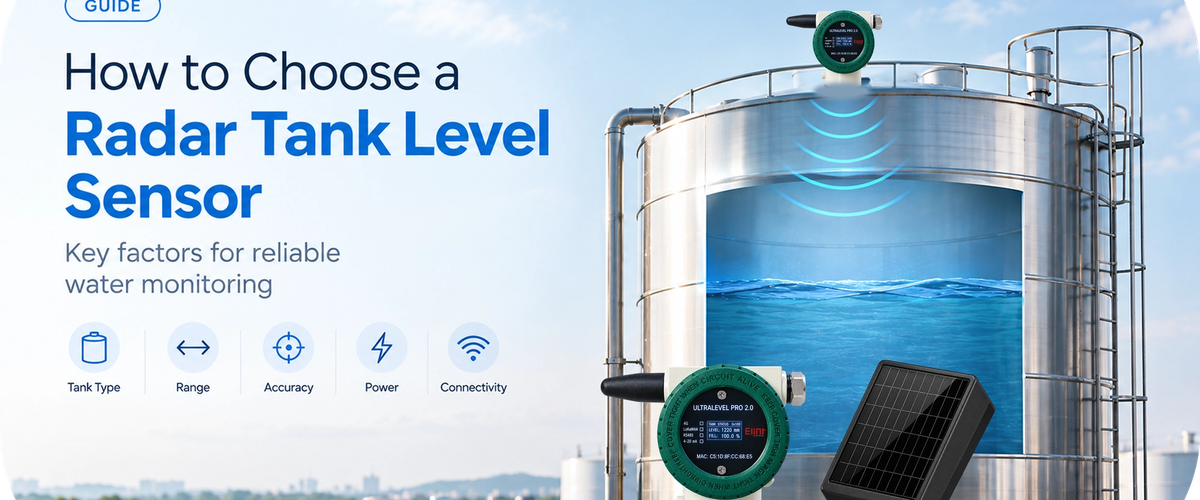
Radar Tank Level Sensor
Choosing a suitable water level sensor is important for preventing tank overflow, avoiding unexpected water shortages and improving day-to-day water management. However, not every sensor is suitable for every tank or installation environment.
For overhead tanks, underground storage systems, commercial buildings and industrial facilities, the right choice depends on measurement range, installation conditions, power availability and how the level data will be used.
A radar level sensor is one option for continuous, non-contact level measurement. When combined with wireless communication and a monitoring platform, it can provide remote visibility into water levels and support pump automation.
This guide explains what to consider when selecting a radar water level sensor for your application.
Understand Your Tank and Measurement Requirements
Start by identifying the type of tank you need to monitor.
An overhead water tank in an apartment has different installation requirements from an underground sump or a large industrial storage tank. Tank height, available mounting space, internal obstructions, and the properties of the stored liquid can all influence sensor selection.
Before choosing a tank level sensor, consider:
- Tank height and required measurement range
- Available mounting space above the liquid
- Tank shape and internal obstructions
- Whether the tank is indoors or exposed to outdoor conditions
- Required measurement accuracy and operating conditions
- Whether you need local readings, remote monitoring, or automated control
These details help narrow down the suitable sensing technology and product configuration.
Why Consider a Radar Level Sensor?
A radar level sensor measures the distance between the sensor and the liquid surface using electromagnetic waves. The measured distance is used to calculate the level based on the configured tank dimensions and reference point.
Unlike contact-based sensors, radar devices can measure the liquid level without a probe or float touching the water.
Potential advantages include:
- Non-contact measurement: No submerged moving parts are required.
- Continuous level readings: Suitable models can provide ongoing measurement rather than only high- or low-level switching.
- Reduced routine intervention: The sensing element does not need to remain submerged.
- Remote monitoring compatibility: Connected models can transmit readings to a dashboard or controller.
- Flexible applications: Suitable radar models can be selected for different storage tanks and operating environments.
Performance still depends on the sensor specifications, mounting position, tank geometry, and installation conditions. Radar is not automatically the best choice for every application.
Check the Measurement Range and Accuracy
The sensor's measuring range must cover the actual operating depth of the tank. Also check the minimum measuring distance, mounting height and any blind zone near the sensor.
Accuracy and resolution are different specifications. Accuracy describes how close a measurement is to the actual value under stated conditions, while resolution describes the smallest measurement increment the device can represent.
For example, My Tank's wireless radar level sensor, measurement range of 5 cm to 22 m and 1 mm resolution. Check the individual product datasheet for the applicable accuracy, operating range and installation requirements before selecting a model.
Correct mounting and configuration are essential for reliable readings.
Choose the Right Power Supply and Connectivity
A water level sensor may be installed on a rooftop, inside a pump room or at a remote storage site. Power and communication requirements should therefore be considered alongside the sensing technology.
Power supply: Depending on the model, options may include solar, battery or external power. Solar-powered systems can be useful where suitable light exposure is available, while battery capacity and charging conditions matter for installations with limited sunlight.
Wireless connectivity: LoRaWAN, 4G, NB-IoT, Cat-M1 and Wi-Fi serve different deployment requirements. The right option depends on network availability, communication distance, power consumption and the site's architecture.
For example, a wireless radar level sensor can send readings from a tank to a compatible gateway or cloud-connected system, reducing the need for long communication cables between the tank and monitoring location.
Explore UltraLevel Max, My Tank's solar-powered radar level sensor for its supported power and communication options.
Consider What You Want to Do With the Level Data
A sensor provides more operational value when its readings support a defined task.
For a single tank, a local level display or high-level alert may be sufficient. For a commercial building with several tanks, remote monitoring and centralized visibility may be more useful.
Depending on the selected system, tank level data can support:
- Low-level and high-level alerts
- Remote viewing through a web dashboard or mobile app
- Historical level records and trend analysis
- Monitoring of multiple connected tanks
- Pump automation based on configured conditions
When level sensors are integrated with suitable smart pump controllers, operations can respond to actual tank conditions instead of relying entirely on manual checks or fixed schedules.
For a broader explanation, read our guide to water tank level sensors and how they work.
Match the Sensor to the Application
Different installations call for different product features.
Apartments and commercial buildings: Prioritize reliable overhead tank monitoring, remote visibility, alerts and compatibility with pump automation.
Underground sumps: Consider access, mounting arrangements and whether a top-mounted radar or a hydrostatic sensor better suits the installation. Explore HydroSense for sump level monitoring.
Industrial storage: Evaluate the liquid being measured, operating conditions, enclosure requirements, measurement range and required integration interfaces. For applications that need industrial interfaces and a local display, review UltraLevel Pro 2.0.
For a comparison of sensing technologies, see ultrasonic versus radar water level monitoring.
How My Tank Supports Wireless Water Tank Monitoring
My Tank combines wireless radar level sensors, remote monitoring and smart pump automation to simplify water management.
- Accurate Level Monitoring: UltraLevel radar sensors provide non-contact measurement, with supported models offering 1 mm resolution and measurement ranges up to 22 m.
- Flexible Power Options: Choose solar-powered, battery-powered or external-power configurations, depending on the model and installation.
- Wireless Connectivity: Supported options include LoRaWAN, 4G, Wi-Fi, NB-IoT and Cat-M1, depending on the model.
- Remote Monitoring: View tank levels, review historical trends and receive alerts through the MyTank platform.
- Smart Pump Automation: Integrate compatible sensors with smart pump controllers to automate pump operation based on tank-level and pressure conditions, helping prevent overflow and unnecessary pump running.
Choose a Sensor Based on Your Application
Selecting a radar level sensor involves more than comparing specifications. Measurement range, mounting conditions, power supply, connectivity and the intended monitoring workflow all influence the final decision.
By evaluating these requirements first, you can choose a suitable water tank level sensor and build a monitoring system that provides useful level data, improves visibility and supports more informed water management.
Not Sure Which Radar Tank Level Sensor Is Right for Your Application?
Let's connect with our team for guidance on choosing the right solution for your tank, measurement range, power supply and connectivity requirements.
Schedule a CallFrequently Asked Questions
What is a radar level sensor?
A radar level sensor measures the distance to a liquid surface using electromagnetic waves and calculates the level from that measurement.
Is a radar level sensor suitable for water tanks?
Yes. A suitable radar model can monitor overhead tanks and other water storage systems when its range, mounting and operating requirements match the application.
What is the difference between a water level sensor and a radar level sensor?
A water level sensor is a general term for devices that measure or detect liquid levels. A radar level sensor is a specific type that uses electromagnetic waves for non-contact measurement.
Can I monitor tank levels remotely?
Yes. A compatible sensor and communication setup can transmit level readings to a monitoring platform, allowing users to view data remotely.
How do I choose between a radar sensor and a hydrostatic sensor?
Consider tank access, mounting arrangements, measurement range, liquid conditions and integration needs. Radar measures from above the surface, while hydrostatic sensors measure pressure associated with the liquid column and are often useful for sumps and underground tanks.