WiFi Water Tank Level Sensor: When to Choose WiFi, LoRa or 4G
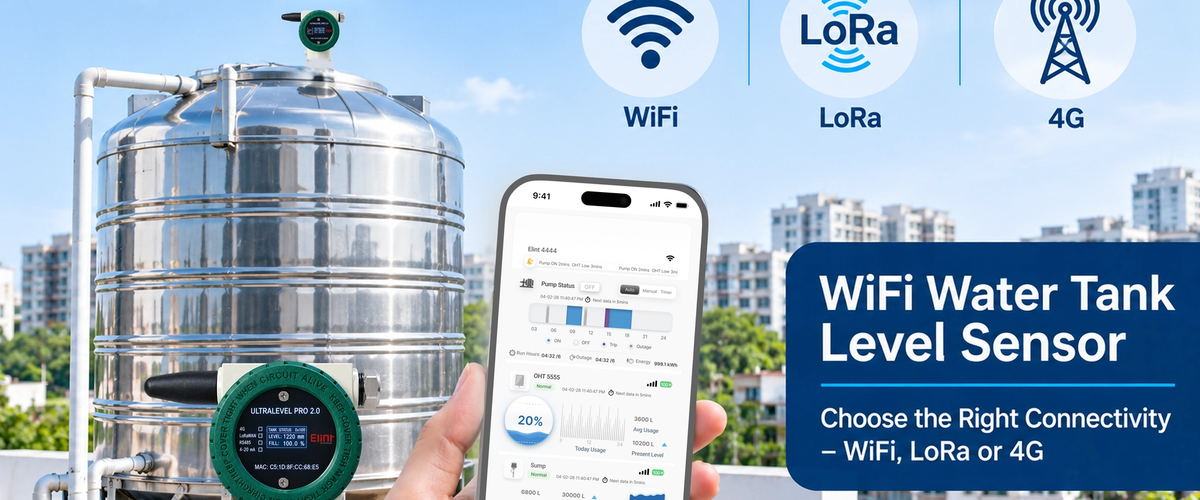
WiFi tank level sensor options for an overhead tank
A WiFi water tank level sensor works well when your tank is close to a router with a steady signal. If the tank is far away, underground or on a site without broadband, LoRa or 4G is usually the better choice.
The right connection matters as much as the sensor itself. A good reading is of little use if it never reaches your phone.
What Is a WiFi Water Tank Level Sensor?
A WiFi water tank level sensor measures how much water is in a tank and sends the reading through a wireless network. You can then check the level on a mobile app or dashboard, without climbing to the terrace.
The system has two jobs:
- Measuring: radar, ultrasonic, pressure or float technology detects the water level.
- Communicating: WiFi, LoRa or a mobile network carries the reading.
These are separate choices. When comparing products, check both. To understand the measuring side, read our guide to types of water tank level sensors.
When WiFi Works Well
WiFi can be a practical option for a small setup. It suits you when:
- The router signal is strong at the tank itself.
- There are few walls or concrete slabs in between.
- Power is available for the sensor, or its battery suits your reporting needs.
- Your internet connection is reliable.
- You need to monitor only one or two nearby tanks.
Before buying, stand next to the tank with your phone and check the WiFi signal.
When WiFi Struggles
Many water tanks sit in places a home router was never meant to reach.
- Rooftop tanks: several concrete floors can weaken the signal.
- Underground sumps: walls, soil and metal covers can block it.
- Large properties: tanks may be well beyond the router's coverage.
- Power cuts: if the router has no backup, remote updates stop.
- Password or router changes: the sensor may need to be set up again.
WiFi vs LoRa vs 4G
WiFi vs LoRa vs 4G Comparision
| Feature | WiFi | LoRa / LoRaWAN | 4G |
|---|---|---|---|
| Range | Short | Long | Wherever there is mobile coverage |
| Needs | Router and internet | Receiver or gateway | SIM and network signal |
| Power use | Usually higher | Low | Usually higher than LoRa |
| Running cost | Home broadband | Depends on gateway and platform | Data plan |
| Best for | Tanks near a router | Apartments, campuses, multiple tanks | Remote or standalone tanks |
Actual range and battery life depend on the product, site layout and how often readings are sent.
LoRa is useful when tanks are spread across a building or campus. Sensors send readings to a gateway, which connects to the internet. 4G is useful when a site has no local network but has good mobile coverage. For a closer look at cabling, see wired vs wireless tank sensors.
A Wireless Option Without WiFi: UltraLevel Pro 2.0
If WiFi cannot reach your tank, consider the UltraLevel Pro 2.0 tank level sensor from My Tank. It is a non-contact radar sensor with 4G, LoRaWAN, NB-IoT and Cat-M1 connectivity options. Confirm which option suits your site before ordering.
Its main features include:
- Measurement range of 5 cm to 22 m, with 1 mm resolution
- Battery, solar or external power options
- IP68 waterproof aluminium enclosure
- 0.96-inch OLED display for readings at the tank
- Bluetooth setup and 2-inch BSP threaded mounting
Because radar measures from above, the sensor does not need to touch the water. For deep sumps where top mounting is difficult, a hydrostatic level sensor may be more suitable.
Which Connection Should You Choose?
- Independent home: choose WiFi if the signal at the tank is strong and stable.
- Apartment or campus: consider LoRa for an overhead tank, sump and other tanks on one system.
- Farm or remote site: consider 4G where mobile coverage is good.
- Weak mobile and WiFi signal: consider LoRa with the gateway placed where internet is available.
Also decide what should happen after a reading arrives. Alerts tell you the tank is low or full, but they do not switch the motor by themselves. For that, you need a compatible single-phase pump controller or three-phase pump controller.
Checklist Before You Buy
- Check the signal strength at the tank location.
- Measure the tank height and confirm the sensor range.
- Decide how the sensor will be powered.
- Ask whether a gateway, SIM or subscription is required.
- Confirm the mounting method for your tank lid.
- Ask what happens to readings and pump control during internet outages.
- Check whether the app supports all your tanks.
Planning to check levels away from home? Read how to monitor your water tank level from your mobile.
Need help deciding?
See the UltraLevel Pro 2.0 radar tank level sensor and share your tank height, location and pump type with our team.
Schedule a CallFrequently Asked Questions
Does a WiFi water tank level sensor work without internet?
It depends on the product. Some offer local readings, but remote viewing and app alerts generally need an internet connection.
Does LoRa need internet?
The link between a LoRa sensor and its receiver does not need internet. Viewing data remotely usually requires an internet-connected gateway.
Can a tank level sensor prevent overflow?
It can warn you when the water is high. With a compatible pump controller, it can also help stop the motor automatically. See our guide to preventing water tank overflow.