Reservoir, Lake and Dam Level Monitoring with Solar-Powered Radar Sensors
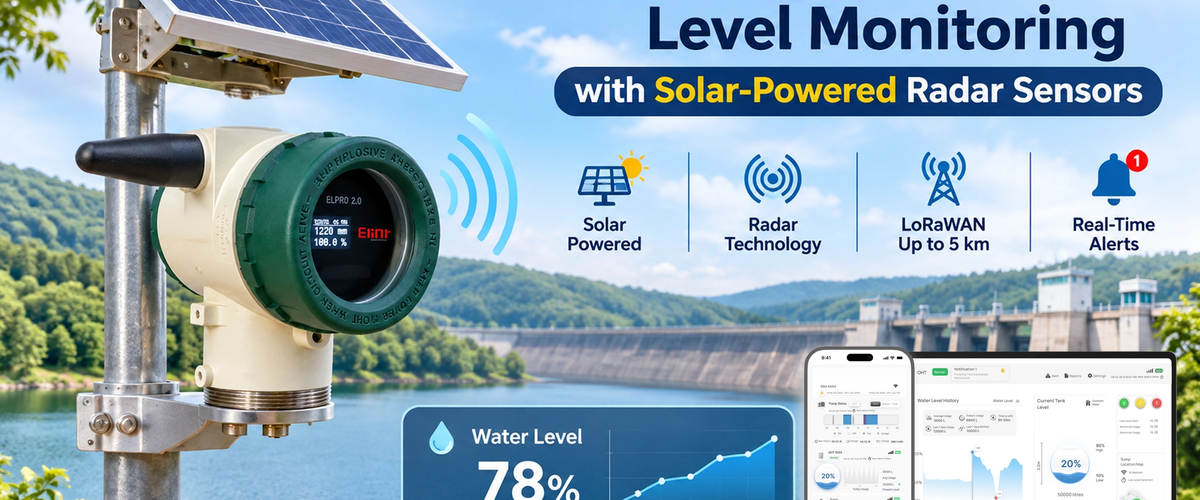
Solar-powered radar level sensor mounted above a reservoir for remote water level monitoring
A reservoir does not stay still. Rain, inflow, irrigation draw-off and evaporation change its level every day. If you only learn about it when someone visits the site, you are always a step behind.
Reservoir level monitoring fixes that. A sensor measures the water level continuously and sends the reading to a dashboard. You see trends, set alerts and act before a shortage or a flood becomes a problem.
This guide explains how solar-powered radar sensors make dam water level monitoring and lake level monitoring practical, even at sites with no power, no cables and no mobile tower nearby.
Why manual readings are not enough
Many reservoirs and lakes are still checked with a staff gauge and a notebook. It works, but it has clear limits:
- Readings are infrequent. A daily or weekly visit misses fast changes during heavy rain.
- Sites are remote. Travel takes time, and access can be unsafe during floods.
- Data is scattered. Paper logs are hard to compare, chart or share.
- Alerts arrive late. Nobody is notified when the level crosses a limit at night.
Continuous water level telemetry replaces visits with live data. You still inspect the site, but you do it when needed, not by habit.
How a radar water level sensor works
A radar tank level sensor sits above the water and points down. It sends a radar signal at the surface and times the echo that returns. From that time it calculates the distance, and from the distance it works out the water level.
Because nothing touches the water, radar is well suited to outdoor surface water:
- No contact, no fouling. Silt, algae, debris and changing water chemistry do not coat the sensor.
- Little maintenance. There are no moving parts to jam or wear.
- Stable in weather. Radar is not thrown off by temperature swings or wind the way some other methods can be.
Want the full explanation? Read how radar level sensors work. If you are comparing technologies, see ultrasonic vs radar water level monitoring.
Why solar power suits reservoirs, lakes and dams
The hardest part of remote monitoring is rarely the sensor. It is power and cabling. Running a cable across a dam wall or along a lake edge is costly, and it can be damaged by floods, animals or vandalism.
A solar-powered radar level sensor avoids all of that. The My Tank UltraLevel Max is built for this kind of site:
- Solar powered with a 1 W panel and about 72 hours of backup when there is no sunlight
- Measurement range of 5 cm to 22 m with 1 mm resolution
- IP66 waterproof housing for outdoor installation
- LoRaWAN communication up to 5 km (open line of sight)
- Plug-and-play installation with no cabling and no tank modification
If you prefer a battery unit for sites with heavy shade, the UltraLevel Pro 2.0 offers an inbuilt 19 Ah battery, an IP68 enclosure and an optional external solar panel.
How the data reaches you
A wireless water level monitoring setup has three simple parts.
- The sensor measures the water level at regular intervals.
- LoRaWAN carries the reading over long distances, up to 5 km in open terrain, using very little power.
- A gateway and the cloud pass the data on through 4G or Wi-Fi to the My Tank app and dashboard.
You can then view live levels and history from your phone or computer, receive alerts, and compare several sites on one screen. A single network can cover many points, such as a reservoir, its inlet channel and a downstream tank, without separate systems.
For more on the wireless trade-offs, see wired vs wireless tank level sensors.
Where this setup works best
Where this setup works best
| Site | What you monitor | Why radar helps |
|---|---|---|
| Irrigation reservoirs and farm ponds | Storage level before and during the season | Plan releases and avoid running dry |
| Village lakes and community tanks | Seasonal filling and draw-down | Track water security without daily visits |
| Raw water reservoirs | Source level feeding a treatment plant | Early warning of low supply |
| Check dams and small dams | Level against safe limits | Alerts before overtopping risk |
| Stormwater retention ponds | Rapid rise during storms | Quick flood awareness |
| Rivers and channels | Stage at a bridge or gauge post | Contactless water level sensor for lakes and rivers |
Municipal teams can combine these readings with supply data. See our guide on smart water management for municipalities.
Installing the sensor: what to plan for
Good readings start with a good mounting point.
- Mount above the water on a structure such as a bridge, spillway, intake tower, gauge post or bracket. The sensor must have a clear view straight down.
- Stay within range. The water surface should be inside the 5 cm to 22 m measuring range, even at its lowest level.
- Keep the beam clear. Avoid pipes, ladders, railings and vegetation directly under the sensor.
- Choose a sunny spot for the solar panel, facing the sun for most of the day.
- Check the LoRaWAN path. Place the gateway with a clear line toward the sensor, and test signal strength before fixing everything permanently.
This suits most small and medium reservoirs, lakes and channels. For very deep sites where the water surface sits beyond 22 m from any mounting point, or where you need a sensor submerged under the surface, a hydrostatic level sensor may be the better fit. If your site is difficult to reach, the tips in monitoring water levels in deep, hard-to-reach tanks also apply.
Setting alerts that actually help
Data is only useful if it triggers action. A simple alert plan works well:
- Low-level alert to protect supply and irrigation schedules
- High-level alert to warn of rising water before it reaches a critical mark
- Fast-change alert when the level rises or falls unusually quickly
- No-data alert if a sensor stops reporting, so a fault is never mistaken for "all is well"
Start with limits your site team already knows, then refine them after the first few weeks of data.
Quick checklist before you choose a system
- Is the water surface within 22 m of a safe mounting point?
- Is there enough sun for a solar panel, or do you need a battery unit?
- How far is the sensor from the gateway?
- Who needs the alerts, and on which device?
- Do you need one site or several on one dashboard?
If you can answer these five questions, you are ready to specify a system.
Bring continuous visibility to your water source
Good decisions about water start with knowing what is in your reservoir right now. Solar-powered radar sensors give you that view without cables, without frequent site trips and without guesswork.
Talk to My Tank Team